
Why Is Speech Hard for Children With Cerebral Palsy? Breathing, Voice, Resonance, Articulation and AAC
- Speech difficulty in cerebral palsy is mainly dysarthria from muscle control problems.
- Breathing, voice, resonance and articulation are trained step by step through play.
- AAC gives a voice now and does not hold back speech.
Contents
Most speech difficulties in children with cerebral palsy come from dysarthria, a motor speech disorder in which weak, stiff or poorly coordinated muscles make speech slow, effortful or hard to understand. Speech is not made by the mouth alone: breathing, the voice, resonance in the nose and mouth, and movements of the tongue and lips all have to work together. This guide, adapted from a Korean speech therapy study note, breaks speech into those subsystems, describes play-based therapy activities for each, explains augmentative and alternative communication (AAC), and outlines the support available in the United States and the United Kingdom.
Why is speech hard for children with cerebral palsy?
Cerebral palsy is a group of lifelong, non-progressive conditions caused by damage to or differences in the developing brain, affecting movement and posture. The muscles used for speech can be affected too. Darley, Aronson and Brown described the main types of dysarthria in 1969, and children with cerebral palsy may show spastic, dyskinetic or ataxic features, or a mix.
Related on CampusDown Law UpAsking for Disability Accommodations in College for the First Time — ADHD, anxiety, a chronic condition, or an injury?
| Subsystem | What it does | Common difficulty in cerebral palsy |
|---|---|---|
| Respiration | Supplies steady breath for speech | Shallow, irregular breathing; short phrases |
| Phonation | Produces voice in the larynx | Weak, strained or short voicing |
| Resonance | Directs sound through mouth or nose | Too much nasal sound |
| Articulation | Shapes sounds with lips, tongue and jaw | Slow, imprecise consonants |
Therapy therefore starts by finding where the speech system breaks down, rather than by teaching more words. Many children with cerebral palsy also have eating and swallowing difficulties, and some have hearing, vision or language needs, so assessment looks at the whole child.

How do therapists work on breathing and voice?
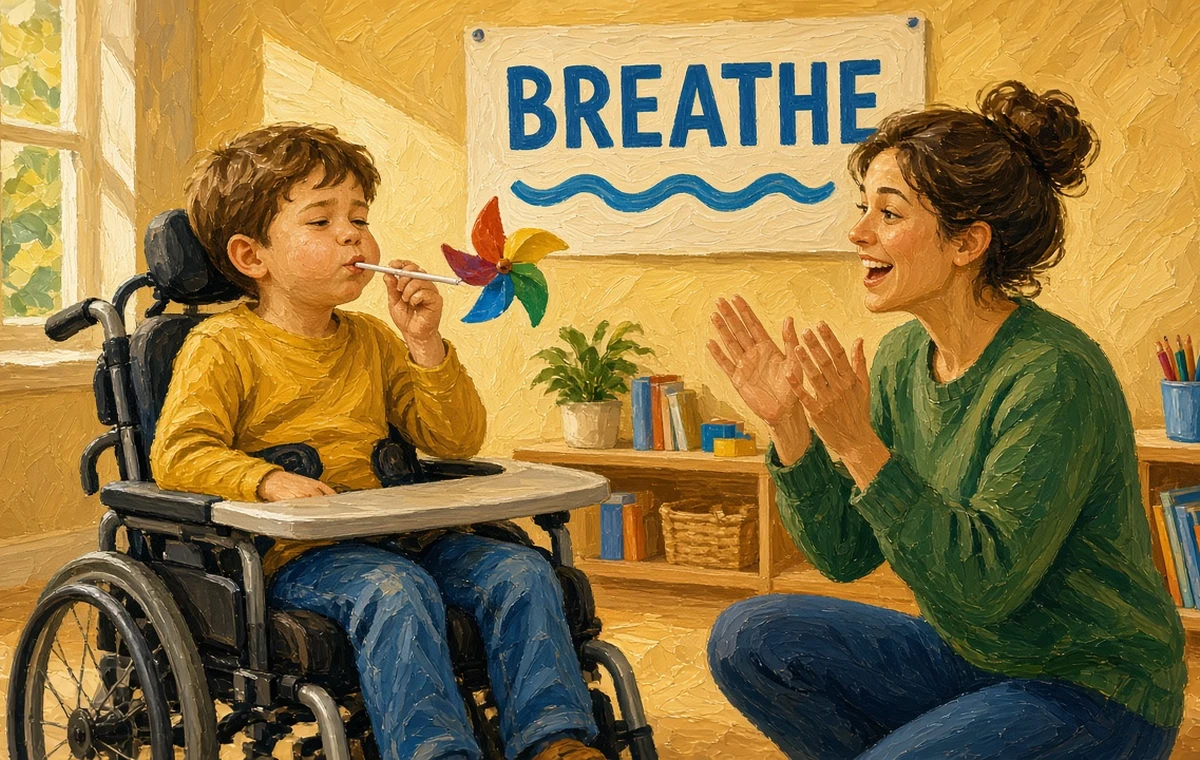
Signs of respiratory difficulty include weak inhalation, shallow or irregular breathing, trouble breathing out slowly, and speaking on very short breaths. Activities include using a straw to move small paper pieces from one basket to another, or blowing a pinwheel steadily for as long as possible. Moving the baskets further apart, or changing how hard to blow by the colour of the pinwheel, practises the length and strength of the outward breath.
Phonation and resonance
For voice, therapists measure maximum phonation time and loudness to see how long and how loud a child can sustain a sound. A child might hold an ah sound while tracing a picture path, or make a toy move by using a louder voice. Resonance depends on the soft palate opening and closing the passage to the nose; when this control is weak, speech sounds too nasal, so listening games that contrast oral and nasal sounds can help alongside breath work.
Skimming the section headings first makes a long guide much easier to map out. Try writing down one question of your own as you read.
How is articulation trained?
Articulation work aims for clear speech in everyday conversation, moving step by step so the child keeps succeeding.
| Task | Content |
|---|---|
| Diadochokinetic rate | Repeating pa-ta-ka quickly to check the speed and regularity of lip and tongue movements |
| Oral movement games | Sticking out the tongue, moving it side to side, rounding the lips |
| Word practice | Starting with easier lip sounds such as m and b, then harder sounds |
| Carry-over | Moving from words to short phrases and real conversation |
One caution: practising mouth movements on their own, without speaking, has limited evidence of improving speech clarity. Choosing activities that combine movement with real speech is part of evidence-based practice, which weighs research, clinical expertise and family priorities together. Keep sessions short, watch for fatigue, and work with physiotherapists and occupational therapists so the child has a stable seated posture, which supports breathing and voice.
What is AAC, and does it slow down speech?

Augmentative and alternative communication (AAC) means any tool or strategy that supplements or replaces speech so a child can express ideas and needs. Parents often worry that AAC will make a child stop trying to talk. Research has not found that AAC holds back speech development; some children try to speak more as their communication succeeds, and having a way to be understood often reduces frustration. Seeing communication barriers as something the environment can remove, as the wiki entry on the medical and social models of disability explains, fits this approach.
| Type | Examples | Good for |
|---|---|---|
| Unaided | Gestures, facial expression, eye gaze, simple signs | On the move, quick messages |
| Low-tech | Picture cards, communication boards, eye-gaze frames | Starting quickly at low cost |
| High-tech | Speech-generating devices, tablet communication apps | Larger vocabularies and sentences |
| Access methods | Large buttons, switches with scanning | Children who cannot point accurately |
Many children with cerebral palsy find precise pointing hard, so the access method matters as much as the device: bigger cells for a fist or palm, an eye-gaze board, or a switch pressed when a light scans to the right item. Choosing a system works best after an assessment with a speech and language therapist.
What support is available in the US and UK?
United States
Under the Individuals with Disabilities Education Act, babies and toddlers can receive speech therapy through early intervention, and school-age children receive speech-language services through an Individualized Education Program. IEP teams must consider whether a child needs assistive technology, which includes AAC devices. The American Speech-Language-Hearing Association publishes practice guidance for clinicians and families.
United Kingdom
NHS speech and language therapy services assess children with cerebral palsy, and in England an Education, Health and Care plan can set out speech and language therapy as educational provision. Children with complex AAC needs can be referred to specialised AAC hubs commissioned by NHS England, and the charity Communication Matters supports AAC users and families.
| Need | United States | United Kingdom |
|---|---|---|
| Early speech therapy | IDEA early intervention | NHS speech and language therapy |
| School support | IEP speech-language services | EHC plan provision |
| AAC devices | Assistive technology in the IEP | Specialised AAC hubs, local services |
In both countries, the strongest plans combine speech practice with a way for the child to communicate right now.
How can families carry practice into daily life?

Also on CampusDown Law Up: Asking for Disability Accommodations in College for the First Time.
Bubble blowing, rolling a paper ball with a straw and floating feathers make long outward breaths fun. Link them to speech: hold an ah sound while breathing out, or say a short word. After one round of bubbles, wait for the child to touch a more card or say more before blowing again, so the child learns that words and pictures make things happen.
Keep practice short and stop while the child is still enjoying it. Use the same vocabulary board at home, nursery and school, start with core words such as more, stop, help and no, model by pointing to the board as you speak, and wait patiently for a reply; counting to ten silently gives the child time to answer.
- Dysarthria from weak or poorly coordinated muscles is the main speech difficulty.
- Therapy targets breathing, voice, resonance and articulation step by step.
- Mouth exercises alone have limited evidence; link movements to real speech.
- AAC does not hold back speech and gives a voice today.
- IDEA in the US and EHC plans and AAC hubs in the UK support families.
FAQ
Is dysarthria the same as aphasia?
No. Aphasia affects understanding and using language, while dysarthria affects the muscle control needed to produce speech.
Do children with dysarthria also have trouble swallowing?
Often, because the same mouth and throat muscles are involved; a speech and language therapist can assess both.
Will AAC stop my child from talking?
Research has not found that AAC holds back speech, and many children try to speak more once they can communicate.
Can we practise at home?
Yes. Bubble and straw games linked to real sounds or words work well; agree activities with your therapist.
How is an AAC system chosen?
After an assessment of vision, understanding, motor control and the most reliable way the child can select items.