
Why Did I Buy That? Stanley Cups, 100-Night Mattress Trials and Foldable Phone Trade-ins Explained by Consumer Psychology
- Most purchases mix your own wants with a seller's push, and consumer psychology studies the balance.
- Limited-edition cups and totes sell through scarcity and social proof, while long mattress trials rely on the endowment effect and loss aversion.
- Foldable phone deals use anchoring, framing and mental accounting, which is why companies study the buyer's decision process first.
Contents
Consumer psychology is the study of the mental shortcuts, emotions and social signals that push us toward a purchase, often before we have consciously decided we want the thing. The coffee you queued for last week felt like your choice. Was it? This guide uses three very American and British buying moments, a limited-edition cup frenzy, a "sleep on it for 100 nights" mattress, and a shiny foldable phone with a trade-in deal, to show how scarcity, ownership and framing quietly do the deciding.
Researchers usually split the forces behind a purchase into two. One is your own want, the genuine wish to own something. The other is the seller's push: promotions, ads and the idealized lifestyle a brand broadcasts until you believe it was your idea all along. Almost every purchase mixes the two, and the ratio is the interesting part.
Why did people camp out for a cup?
In January 2024, a pink Valentine's Day Stanley Quencher made with Starbucks went on sale at Target. Shoppers lined up before dawn, videos of sprinting customers went viral, and within hours the $49.95 tumblers were listed on resale sites for several hundred dollars. Two months later Trader Joe's released mini canvas tote bags for $2.99, and the same thing happened: sold out, then resold online for many times the price.

Psychologist Robert Cialdini named the two engines behind these scenes in his classic book Influence. Scarcity makes anything that might run out seem more valuable, and social proof tells us that if hundreds of people are lining up, the thing must be worth it. Add a TikTok feed full of unboxing clips and you get a textbook bandwagon effect. Notice what is barely involved: the cup's ability to keep water cold. Plenty of cheaper tumblers do that. The purchase was really about belonging to a moment.
A useful self-test: would you still want it if it were permanently in stock in every color, with no line at all? If the answer is "probably not", the seller's push was doing most of the work.

How does a 100-night mattress trial change your decision?
Buying a mattress online sounds risky, which is why direct-to-consumer brands made the risk disappear. Casper and Purple built their US launches around 100-night home trials, and in the UK Simba offers a 200-night trial. Return rates are lower than you might expect, and behavioral economics explains why.
- Endowment effect: in a famous 1990 experiment by Kahneman, Knetsch and Thaler, students given a coffee mug asked roughly twice as much to sell it as other students would pay to buy it. Once the mattress is on your bed, it is "yours" and feels worth more.
- Loss aversion: sending it back feels like losing something, and prospect theory shows losses hurt about twice as much as equal gains please.
- Hassle cost: the box is gone, the bed is made, and arranging a pickup is effort you keep postponing.
- One-stop journey: compare models, read reviews, check out and track delivery on one website, with no salesperson in sight.
Here is a fun coincidence: the same name, Casper, belongs to a small Hyundai car in South Korea that was famously sold almost entirely through its own website, from 3D configuration to e-signed contract. Two very different products, one shared insight: removing friction from the journey is itself a sales tool.
| Market | Legal right for online purchases | What brands add |
|---|---|---|
| UK | Consumer Contracts Regulations 2013: 14-day cooling-off period to cancel most online orders | Long trials such as Simba's 200 nights go far beyond the legal minimum |
| US | No general federal right to return online purchases; the FTC Cooling-Off Rule covers door-to-door type sales | Trials and free returns are voluntary marketing promises, so read the fine print |
Before you start any free trial, put a reminder in your calendar a week before it ends. It is the easiest way to make sure you are judging the product, not your own inertia.
Skimming the section headings first makes a long guide much easier to map out. Try writing down one question of your own as you read.
Why is a foldable phone with a trade-in so tempting?
Foldable phones such as Samsung's Galaxy Z Fold and Z Flip sell on novelty and design: a big screen that closes like a book, a larger cover display, stylus support on the folding models. But the moment of decision in an Apple or Samsung store is usually shaped by the price tag, and the price tag is carefully framed.
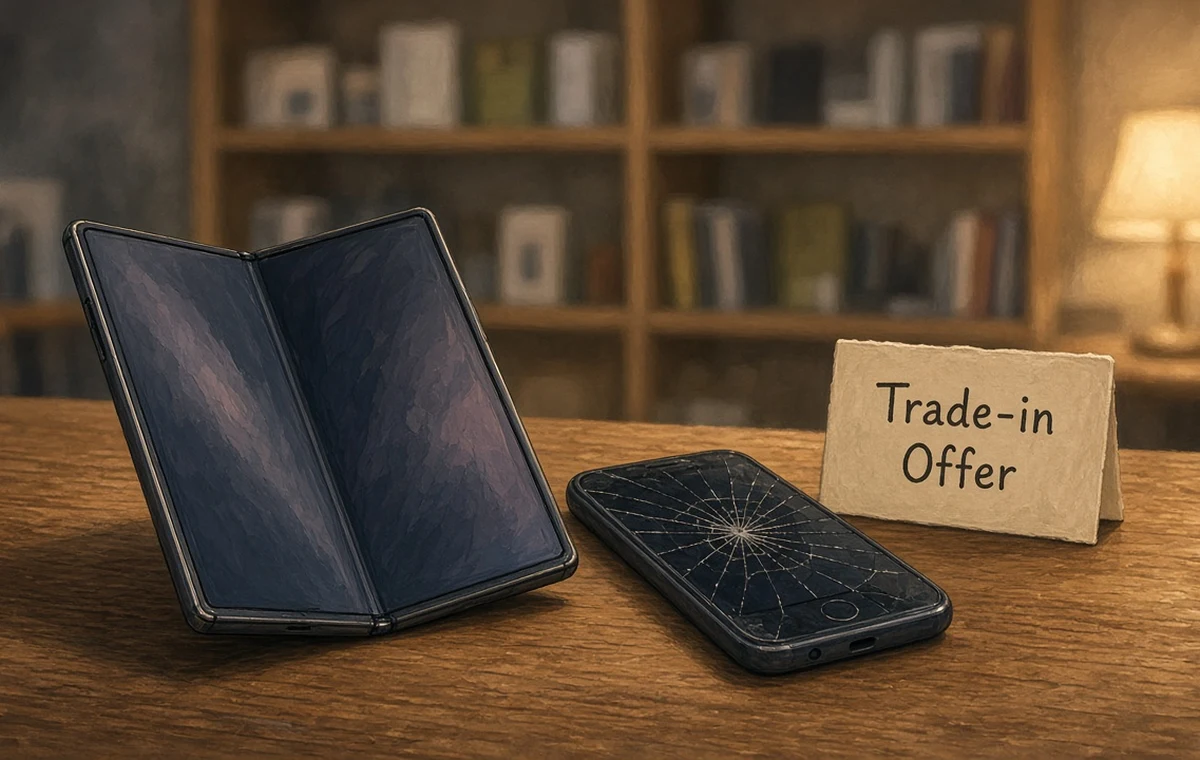
- Anchoring: a launch price near two thousand dollars becomes the reference point, so "only $X a month" feels small by comparison. See the anchoring effect for how the first number sticks.
- Framing: "Save up to $1,000 with trade-in" sounds like a gift, even though the top figure usually needs a recent flagship in perfect condition plus a specific carrier plan.
- Mental accounting: Richard Thaler showed we treat money differently depending on its label. Trade-in credit feels like "found money", so we spend it more freely than cash.
| Purchase | Main trigger | What the seller controlled |
|---|---|---|
| Limited-edition tumbler or tote | Scarcity and social proof | Release date, quantity, color drops |
| Online mattress with home trial | Endowment effect and loss aversion | Trial length, free delivery, easy checkout |
| Foldable phone with trade-in | Anchoring, framing and mental accounting | Launch price, monthly breakdown, trade-in headline |
Put the three side by side and a pattern appears. None of these purchases was irrational, but each one was nudged by a design choice someone made on purpose.
Why does consumer psychology matter to companies?
Companies today talk about sustainable management: cutting costs, yes, but also social responsibility and environmental soundness. None of that survives unless enough customers keep choosing their products. So firms invest heavily in customer satisfaction, aiming to exceed expectations so loyal buyers do not drift to competitors.
That is why understanding the buyer's decision process comes first in any marketing plan, and why consumer psychology, from Daniel Kahneman's work on judgment to Richard Thaler and Cass Sunstein's Nudge, is already woven into the checkout pages we click every day. For shoppers, the lesson is simple and liberating: notice the trigger, name it, and then decide whether you still want the thing.
Reference: Solomon, M. R. (2020). Consumer Behavior: Buying, Having, and Being (13th ed.). Pearson, a standard textbook on consumer behavior and purchase decisions.
FAQ
What is the difference between self-driven and seller-driven buying?
Self-driven buying starts from your own wish to own something, while seller-driven buying is triggered by promotions, ads and brand image. Most purchases mix both.
Why do limited editions sell out so fast?
Scarcity makes items feel more valuable and long lines or viral videos add social proof, so demand spikes beyond what the product's function alone would justify.
Why do so few people return mattresses during free trials?
The endowment effect makes things we own feel more valuable, loss aversion makes returning feel like a loss, and the hassle of arranging a pickup adds friction.
Do I have a legal right to return online purchases?
In the UK, most online orders carry a 14-day cooling-off period under the Consumer Contracts Regulations 2013. In the US there is no general federal right, so the retailer's own policy decides.
How can I avoid anchoring when buying a phone?
Compare the total cost over the contract, check the trade-in value your actual phone gets, and decide your budget before you see the launch price.