
Why Do Darts Miss Even When You Aim at the Same Spot? Neural Noise, Bayesian Decision Theory and the Brain
- One of the brain's key jobs is producing movement, with commands and sensory feedback constantly flowing back and forth.
- Noise in the nervous system and ambiguity in the environment mean the same movement varies slightly every time.
- The brain copes by combining uncertain senses with prior knowledge, as Bayesian decision theory describes.
Contents
Darts land in slightly different places even when you aim at the same spot because the nervous system is noisy and the world is ambiguous, so the brain has to estimate rather than know; Bayesian decision theory describes how it combines uncertain sensory signals with prior knowledge to make the best possible guess. This review follows Norwegian neurologist Kaja Nordengen's popular science book on the brain, published in English as Your Superstar Brain, through movement control, neural noise, Bayesian decision theory and human evolution, with corrections and British and American context along the way.
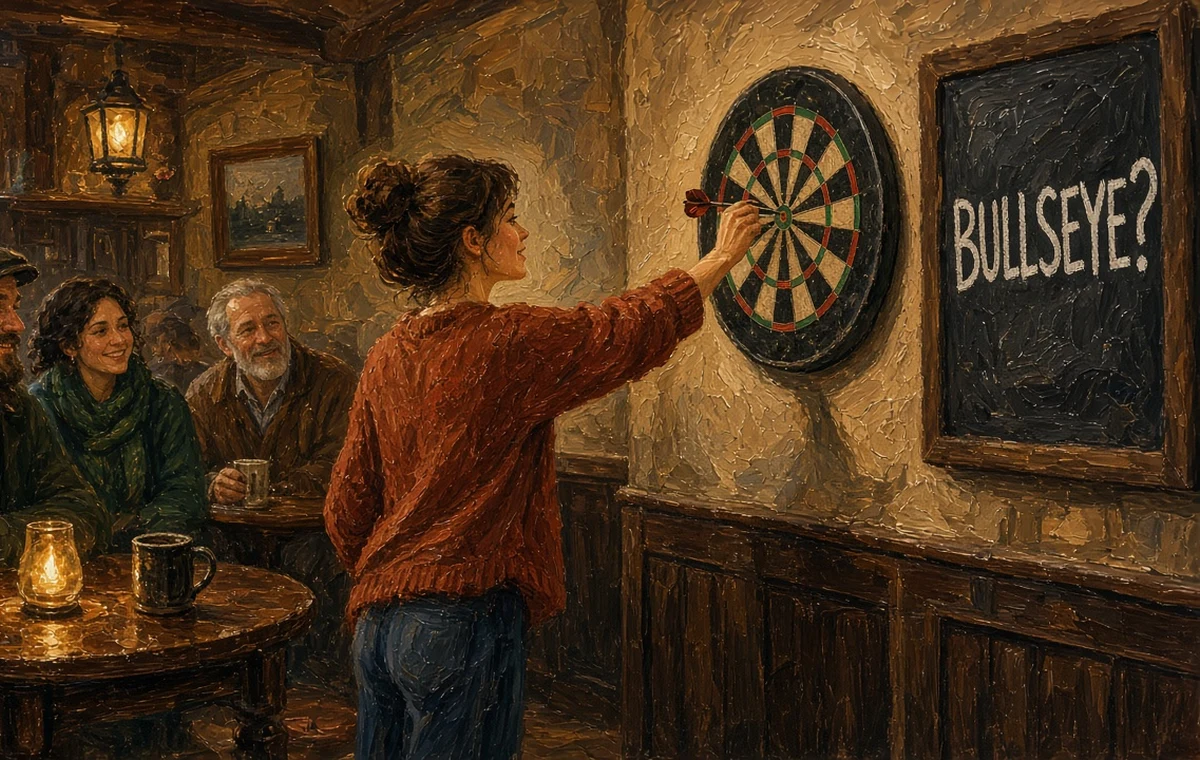
Anyone who has played darts in a pub knows the frustration: the same stance, the same aim, and yet the darts scatter. Far from being a personal failing, that spread is a window into one of the hardest problems the brain solves every second.
Why does the brain produce movement?
The book argues that one of the brain's most important jobs is to generate movement. How the brain controls motion is a hard question, but thinking about what it would take to build a machine that thinks and moves like a person offers useful clues. Neuroscientist Daniel Wolpert has made a similar point, arguing that brains evolved above all to produce adaptable movement.
Student money tip from CampusDown Life UpHow to Find Unclaimed Money in Your Name — How to find unclaimed money in your name for free: official state databases via NAUPA and MissingMoney.com, federal searches like Treasury…
Robots can calculate near-optimal movements, but translating those calculations into smooth physical action remains difficult, which is why robots with truly dexterous hands are still rare. Roboticist Hans Moravec noted the same paradox in the 1980s: what feels effortless for humans, like picking up a cup, is often the hardest thing for machines.

How do commands, feedback and neural noise interact?
Movement happens when the brain's commands reach the muscles, the muscles contract, and the arm and body move while sending feedback back from vision, skin and muscles. But just like the hiss you hear when tuning a radio, the nervous system has its own noise, which interferes with detecting signals accurately.
That is why darts aimed at the same point land in different places. As the body senses an ambiguous and variable environment, many small disturbances creep in, so neither perception nor action is ever perfectly consistent. Research reviewed by Faisal, Selen and Wolpert in 2008 showed that noise appears at every stage, from sensory receptors to motor neurons, and that larger, faster movements tend to carry more of it.
Skimming the section headings first makes a long guide much easier to map out. Try writing down one question of your own as you read.
How does Bayesian decision theory explain movement?
The book explains the brain's effort to move accurately despite this interference using Bayesian decision theory. The idea is that the brain weighs uncertain sensory information against what it already knows to reach the most plausible judgement, much as a darts player unconsciously adjusts for a board they have practised on many times.

A well-known experiment by Körding and Wolpert, published in Nature in 2004, supported this view: when people reached for targets with uncertain visual feedback, they combined that feedback with a learned expectation in the way a Bayesian model predicts. Seen this way, a clumsy movement is not the brain failing but the brain making its best estimate under noisy conditions.
What makes the human brain special in evolution?
The book notes a common misconception that humans descend from chimpanzees or gorillas. In fact, humans and chimpanzees share a common ancestor, and fossil and genetic evidence places the split at roughly five to seven million years ago. The book adds a memorable analogy: compress the history of life into a single year and the human-chimpanzee split happened only about 18 hours before midnight on 31 December. The exact figure depends on when you start the clock, but the point stands that our lineage is a very recent twig.
Two terms in the book need updating. The source describes hominids as the human branch and hominoids as apes and humans together, but current classification uses hominin for the human lineage, hominid for great apes and humans, and hominoid for all apes, including gibbons, plus humans. The book also says no animal matches humans for the number of cortical neurons; that holds among primates, but counts published in 2014 found more neocortical neurons in the long-finned pilot whale.
| Term or comparison | The book's explanation | Current usage or note |
|---|---|---|
| Hominid | The human side of the evolutionary branch | Today the human lineage is called hominin; hominid covers great apes and humans |
| Hominoid | Apes and humans in a broad sense | All apes, including gibbons, plus humans |
| Body-size difference | Male gorillas about twice the weight of females, human men about 1.2 times women | Consistent with standard estimates |
| Cerebral cortex | No animal matches humans in cortical neurons | True among primates, but some whales have more |
These differences are used to show how the human brain and human societies developed in distinctive directions over a long evolutionary timescale.
Where can you see these ideas in the UK and US?
Bayesian thinking has a British birthplace. Thomas Bayes was an English Presbyterian minister whose essay on probability was published in 1763, after his death, by his friend Richard Price, and he is buried in Bunhill Fields in London. Darts, too, is a British pub tradition that became a televised sport, where professional players still produce tight clusters rather than a single repeated hole, a nice live demonstration of motor noise.
Museums that tell the evolution story
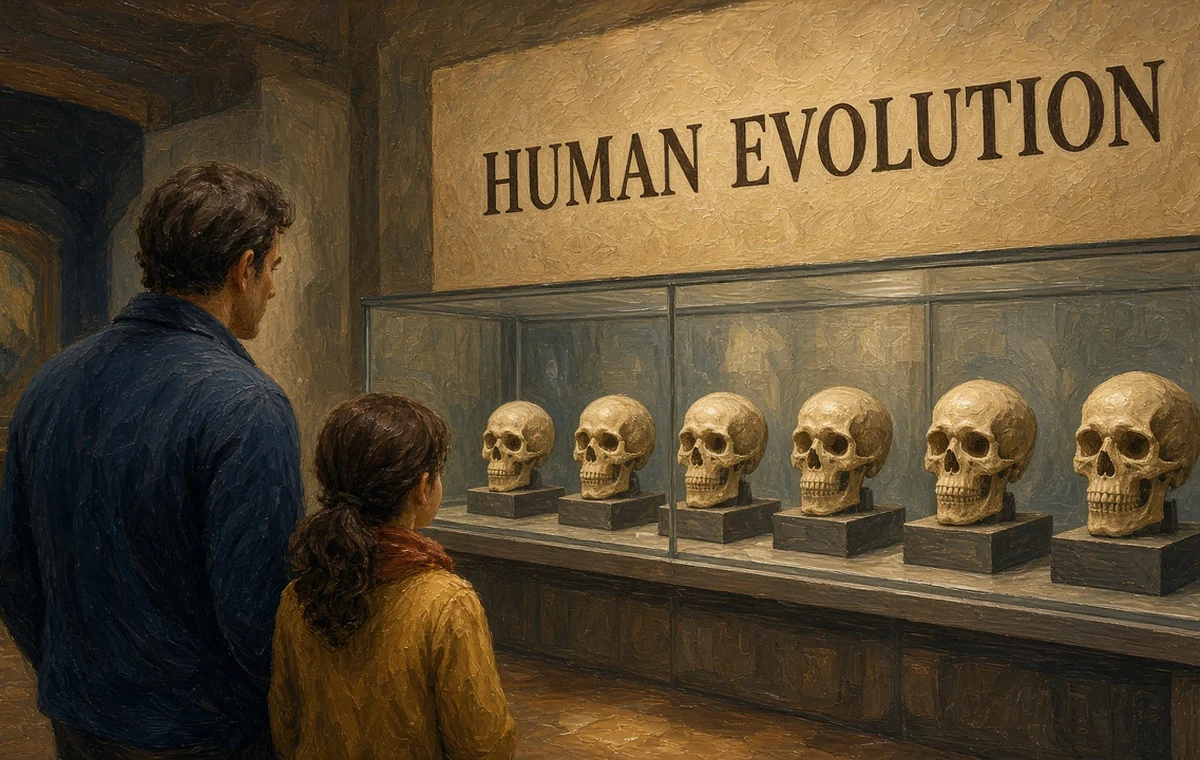
For the evolutionary side of the book, the Natural History Museum in London and the Smithsonian's Hall of Human Origins in Washington, D.C. both display casts of early human skulls alongside explanations of shared ancestry. Seeing the specimens side by side makes it obvious why a family tree with branches, rather than a ladder, is the right picture.
| Idea in the book | British example | American example |
|---|---|---|
| Neural noise | Pub darts and televised darts | Free throws in basketball |
| Bayesian inference | Thomas Bayes and Richard Price, London | Bayesian models in robotics and AI research |
| Shared ancestry | Natural History Museum, London | Smithsonian Hall of Human Origins |
Linking abstract ideas to familiar scenes like these is exactly what makes popular science stick, and it is a useful habit for any book report.
How should you structure a book report?
Split the brain's role in movement into command, execution and feedback, quote the radio and darts examples to explain noise and variability, sum up Bayesian decision theory in one sentence, and use a table to separate the evolutionary terms. For the maths behind the theory, see Bayes' theorem, and for the long timescale of human origins, see evolution.
Student money tip on CampusDown Life Up: How to Find Unclaimed Money in Your Name.
A popular science review is most convincing when it ties core ideas to everyday examples, so make full use of the book's analogies. Even a single movement hides a remarkably sophisticated calculation.
Reviewed by the CampusDown editorial team, November 2026. Reference: Nordengen, K. (2016). Hjernen er stjernen (English edition: Your Superstar Brain, 2018; Korean edition 2019).
FAQ
Why does the same movement vary each time?
Noise in the nervous system and ambiguity and variability in the environment mean perception and action are never perfectly consistent.
What is Bayesian decision theory in movement?
The idea that the brain combines uncertain sensory information with prior knowledge to choose the most plausible action, supported by experiments such as Körding and Wolpert (2004).
What is the difference between hominin, hominid and hominoid?
Hominin is the human lineage, hominid covers great apes and humans, and hominoid covers all apes including gibbons plus humans.
When did humans and chimpanzees split?
Fossil and genetic evidence places the split from a common ancestor at roughly five to seven million years ago.
Who was Thomas Bayes?
An English Presbyterian minister whose essay on probability was published posthumously in 1763 by Richard Price.