
The 12 Earthly Branches Time Table: Chinese Double Hours from Zi (Rat) to Hai (Pig), Solar Time and Midnight Boundaries
- The twelve Earthly Branches split the day into twelve two-hour windows, from the Rat hour (23:00 to 01:00) to the Pig hour (21:00 to 23:00).
- The Rat hour straddles midnight, and local solar time can differ from the clock by half an hour or more in Seoul.
- Use the table for learning, and keep original dates and times when you work with historical records.
Contents
- The full table: twelve branches, twelve animals, twenty-four hours
- Why "the Rat hour is midnight" is only half right
- Solar time versus standard time: why 23:30 in Seoul is not 23:30 in the sky
- Romans, Babylonians and monks: how the West split the day
- Reading East Asian history, novels and K-dramas
- Sources and scope
- FAQ
The twelve Earthly Branches divide the day into twelve "double hours", each two modern hours long: the Hour of the Rat (Zi) runs from 23:00 to 01:00, the Ox (Chou) from 01:00 to 03:00, the Tiger (Yin) from 03:00 to 05:00, and so on until the Pig (Hai) closes the day from 21:00 to 23:00. The single most useful thing to remember is that each name is a two-hour window, not a single moment. In Chinese the system is called shichen; Korea and Japan used the same twelve branches under their own pronunciations, which is why a K-drama character can whisper about "the hour of the Rat" and a Japanese ghost story can begin at the hour of the Ox.
The full table: twelve branches, twelve animals, twenty-four hours
| Branch (Chinese, pinyin) | Animal | Modern clock window |
|---|---|---|
| 子 Zi | Rat | 23:00 to 01:00 (next day) |
| 丑 Chou | Ox | 01:00 to 03:00 |
| 寅 Yin | Tiger | 03:00 to 05:00 |
| 卯 Mao | Rabbit | 05:00 to 07:00 |
| 辰 Chen | Dragon | 07:00 to 09:00 |
| 巳 Si | Snake | 09:00 to 11:00 |
| 午 Wu | Horse | 11:00 to 13:00 |
| 未 Wei | Goat | 13:00 to 15:00 |
| 申 Shen | Monkey | 15:00 to 17:00 |
| 酉 You | Rooster | 17:00 to 19:00 |
| 戌 Xu | Dog | 19:00 to 21:00 |
| 亥 Hai | Pig | 21:00 to 23:00 |
Student money tip from CampusDown Repair UpIs a small leak worth a renters insurance claim? How to decide — compare the loss with your deductible, check who is responsible, and document it either way.
Read each end time as the start of the next window. If 09:00 is the boundary between Dragon and Snake, then 08:59 is Dragon and 09:00 is Snake. Using "start included, end excluded" avoids the classic overlap where one minute seems to belong to two hours.
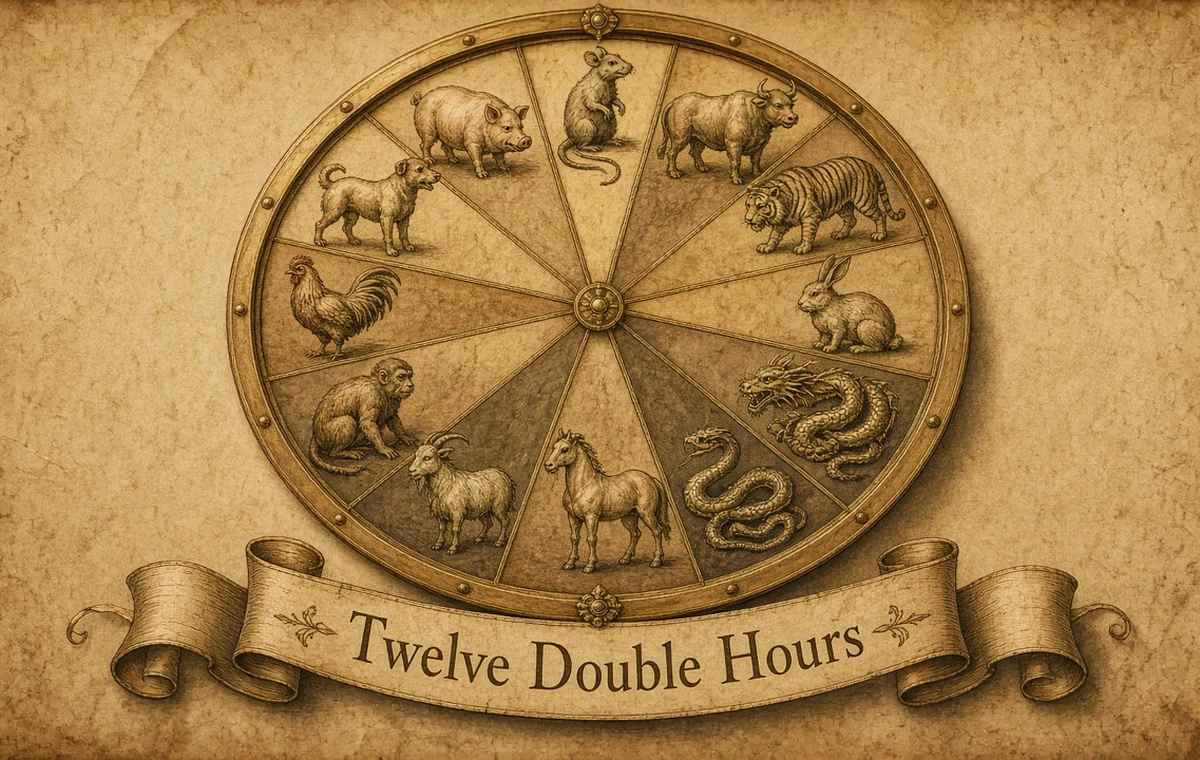
A handy anchor: the Horse hour (Wu, 11:00 to 13:00) is centred on noon, which is why the Chinese word for noon, zhengwu, literally means "exact Horse". The Rat hour is centred on midnight. Learn those two and you can count your way to any of the others.

Why "the Rat hour is midnight" is only half right
The Rat hour is centred on 00:00, but the whole window runs from 23:00 to 01:00, so both 23:30 and 00:30 fall inside it, on different calendar dates. Classical texts sharpen this further by splitting each double hour into an "initial" half and a "central" half. The initial Rat (roughly 23:00 to 00:00) and the central Rat (roughly 00:00 to 01:00) are separate ideas, and the second one is where the modern meaning of "midnight" comes from.
| Modern clock | Branch | What to watch |
|---|---|---|
| Day 1, 22:40 | Pig | Still before 23:00 |
| Day 1, 23:20 | Rat (first half) | The calendar date has not changed yet |
| Day 2, 00:20 | Rat (second half) | Same branch, but the modern date has rolled over |
This is why horoscope websites disagree about people born just before midnight. Some fortune-telling schools start the new day at 23:00, others at 00:00. That is a rule inside a particular divination tradition, not a property of the clock, so keep the original date and time of any record and add the branch beside it, rather than replacing one with the other.
Skimming the section headings first makes a long guide much easier to map out. Try writing down one question of your own as you read.
Solar time versus standard time: why 23:30 in Seoul is not 23:30 in the sky
The old branches followed the sun. Modern clocks follow a time zone. The gap between the two can be surprisingly large, and it explains much of the confusion in East Asian history and astrology.
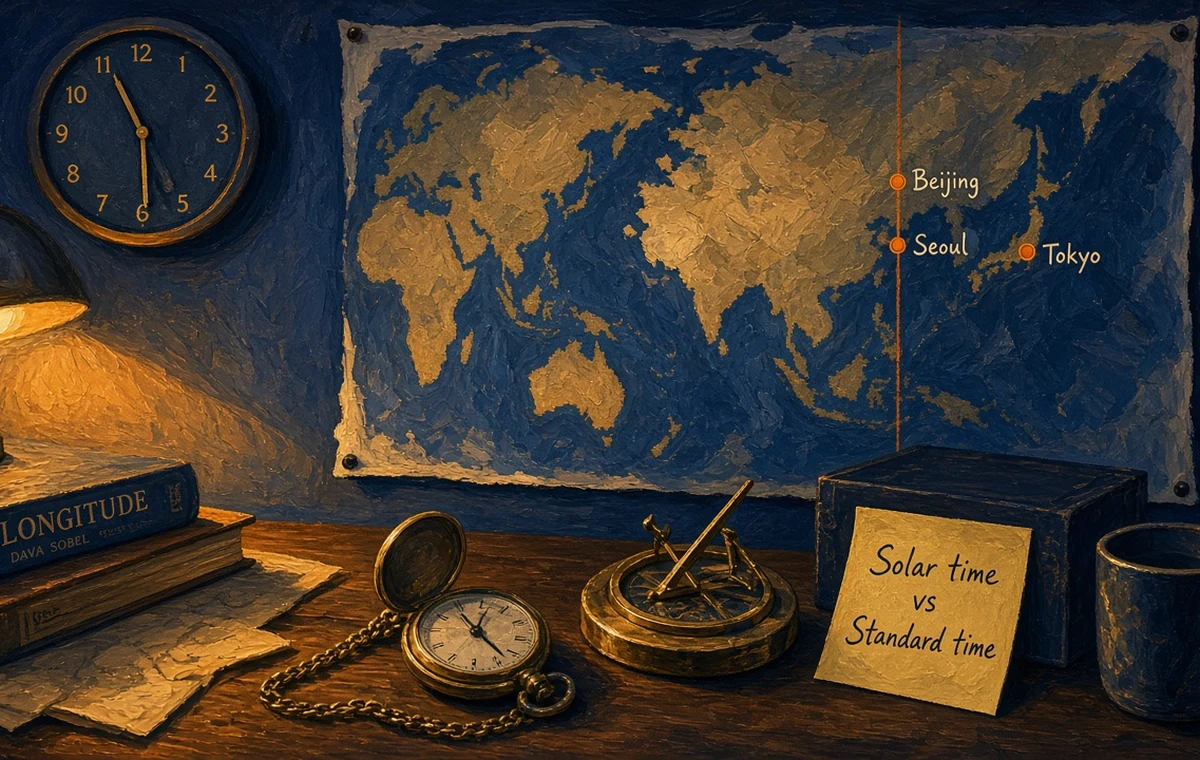
The rule of thumb is that every degree of longitude equals four minutes of solar time. Korea Standard Time (UTC+9) is based on the 135°E meridian, but Seoul sits near 127°E, so local solar time in Seoul runs about 32 minutes behind the clock. Beijing (about 116.4°E) runs roughly 14 minutes behind China Standard Time, which is set at 120°E. Tokyo (about 139.7°E) is around 19 minutes ahead of Japan Standard Time. On top of that, the "equation of time", caused by Earth's tilted axis and elliptical orbit, nudges solar noon by up to about 16 minutes either way across the year.
| City | Longitude | Standard meridian | Solar time vs clock |
|---|---|---|---|
| Seoul | about 127.0°E | 135°E (UTC+9) | about 32 min behind |
| Beijing | about 116.4°E | 120°E (UTC+8) | about 14 min behind |
| Tokyo | about 139.7°E | 135°E (UTC+9) | about 19 min ahead |
| Kashgar | about 76.0°E | 120°E (UTC+8) | almost 3 hours behind |
So a birth recorded at 23:20 Seoul time actually happened when the sun said roughly 22:48, still in the Pig hour by solar reckoning. Do not, however, subtract a fixed 30 minutes from every Korean record. Korea has changed its standard meridian several times in the twentieth century and used summer time in some years, so the right correction depends on the date, place and the clock system in force.
Romans, Babylonians and monks: how the West split the day
East Asia was not alone in counting by twelves. Babylonian astronomers worked in base sixty, which still gives us sixty minutes and sixty seconds, and they divided the day into twelve "double hours" of their own. Ancient Egyptians counted twelve hours of daylight and twelve of night, and the Romans followed, numbering daytime hours from hora prima at sunrise to hora duodecima at sunset. Because daylight is longer in summer, a Roman summer hour was longer than a winter one. These "temporal" or unequal hours are exactly like the seasonal hours used in Edo Japan.
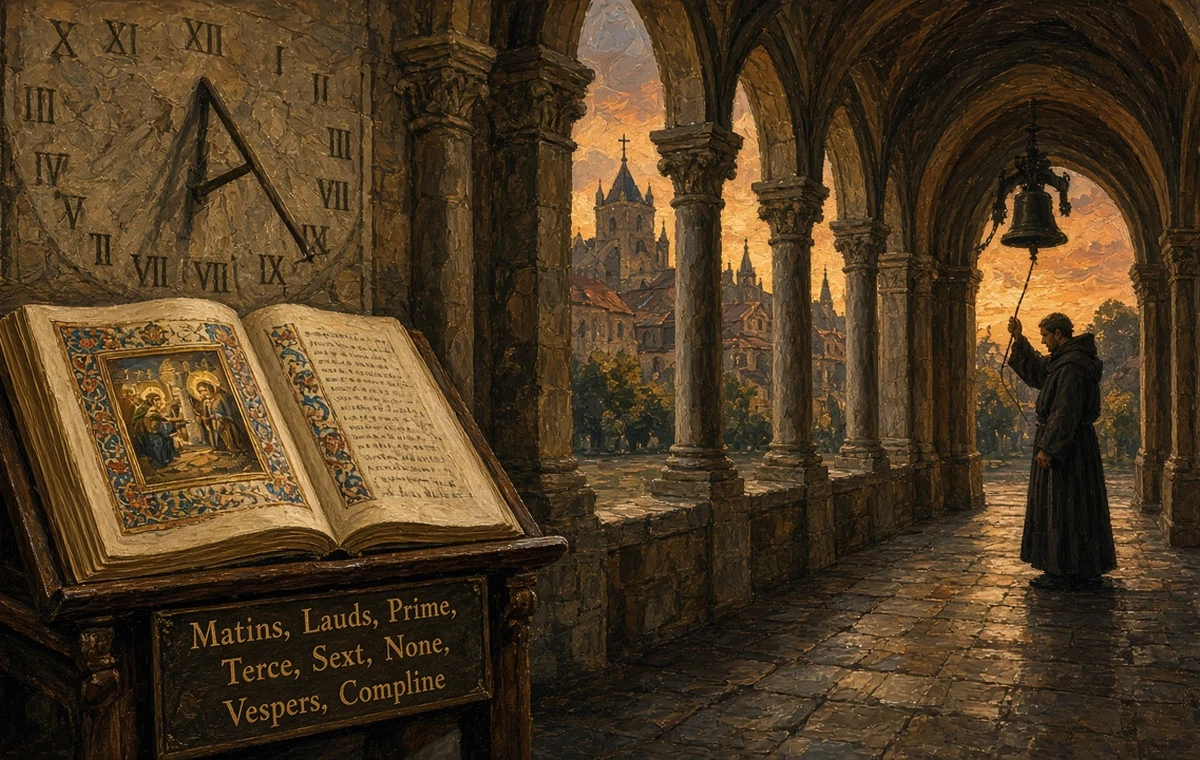
Medieval monasteries timed prayer by the canonical hours: Matins, Lauds, Prime, Terce, Sext, None, Vespers and Compline. "None", the ninth hour after sunrise, gradually drifted earlier in the day and eventually gave English the word "noon". Equal hours spread only after mechanical clocks appeared in European towers in the fourteenth century, and standard time zones came later still, pushed by railways, Greenwich Mean Time and the 1884 International Meridian Conference.
| Feature | East Asian branches | Roman and medieval hours |
|---|---|---|
| Units per day | 12 double hours | 12 day hours and 12 night hours |
| Length | Fixed two-hour windows in standard tables | Seasonal, unequal hours |
| Anchor point | Midnight (Rat) and noon (Horse) | Sunrise and sunset |
| Instruments | Sundials, water clocks, drums and bells | Sundials, water clocks, church bells |
The parallel is closest with Japan. Until 1873, Edo-period Japan also used seasonal hours, dividing daylight and darkness into six parts each, so a summer daytime hour was longer than a winter one, just as in Rome. China and Korea, by contrast, mostly kept the twelve branches as equal divisions tied to water clocks.
Reading East Asian history, novels and K-dramas
Night-time in Joseon Korea had a second layer called the five watches. The night between dusk and dawn was cut into five watches, each split into five points, and their length changed with the seasons. When a palace guard in a historical K-drama says "the third watch has passed", he means the middle of the night, roughly the Rat hour. The capital's day began and ended by bell: 28 strokes around the second watch closed the city gates for curfew, and 33 strokes before dawn reopened them. The modern New Year's bell at Bosingak in central Seoul is still struck 33 times.
Instruments made those signals reliable. In 1434, under King Sejong, the engineer Jang Yeong-sil built the Jagyeongnu, a self-striking water clock whose figures struck a bell, a drum and a gong at set times, alongside the bowl-shaped public sundial called the Angbu Ilgu. China had its own rich tradition of multi-vessel water clocks, and Chinese readers know the twelve-hour rhythm from the hit 2019 drama The Longest Day in Chang'an, whose original title literally means "the twelve shichen of Chang'an". For the wider cosmology behind the branches, see our explainer on yin-yang and the five phases, which is further reading rather than a source for this article.
Editor's tip: Keep learning tables and historical reconstruction apart. Saying "the Rooster hour is 17:00 to 19:00 in the standard table" is safe. Saying "that chronicle entry happened at exactly 18:00" needs the place, the season and the time system first.
Where people usually get stuck
Imagine a student converting two fictional records, "Day 1, 23:20" and "Day 2, 00:20", into branches. Both are Rat hour in the standard table, yet their modern dates differ. The safe method is to keep the original date and time, then add the branch beside it. That still does not settle which "day" a particular fortune-telling school would assign.
Common mistakes
- Writing the Rat hour as the single instant 00:00.
- Deleting the original date once you have found the branch name.
- Subtracting one fixed number of minutes for every place and period.
Self-check
- Did I keep the original date and time of the record?
- Did I read window boundaries without overlap?
- Did I separate the standard table from a historical reconstruction?
- Did I flag uncertainty when the place or time system is unknown?
Sources and scope
- National Folk Museum of Korea, the twelve zodiac animals and their hours
- Encyclopedia of Korean Culture, entries on the 12-hour and 100-mark system and on time systems
- Royal Museums Greenwich, the equation of time and the history of GMT
- Dohrn-van Rossum, G. History of the Hour: Clocks and Modern Temporal Orders (University of Chicago Press)
Student money tip on CampusDown Repair Up: Is a small leak worth a renters insurance claim? How to decide.
Compiled by the CampusDown editorial team from public museum, encyclopedia and observatory sources. Reviewed 14 November 2026. Solar-time offsets are approximations based on longitude only. This guide gives a standard learning table, not minute-level historical conversions or horoscope rulings.
FAQ
Is 3 p.m. the Goat hour or the Monkey hour?
In the standard table 15:00 is the start of the Monkey hour (Shen). Each end time belongs to the next window.
Why does the Rat hour start at 11 p.m. instead of midnight?
Because the Rat hour is a two-hour window centred on midnight, it begins an hour earlier at 23:00 and ends at 01:00.
Can I just subtract 30 minutes from Korean time to get old solar time?
Not reliably. Seoul's longitude puts solar time about 32 minutes behind the clock, but the equation of time, the place and Korea's past changes of time zone and summer time all matter.
Did the West ever use a similar twelve-part system?
Yes. Babylonians used twelve double hours, and Romans counted twelve seasonal hours of daylight, which is close to the unequal hours of Edo Japan.
What does the third watch mean in historical K-dramas?
Joseon Korea divided the night into five watches, so the third watch is the middle of the night, roughly the Rat hour around 23:00 to 01:00.