
Why Is "Just One More Match" So Hard to Stop? Teen Gaming Disorder Under ICD-11, the AAP Family Media Plan, the UK Online Safety Act and Step-by-Step Help
- ICD-11 defines gaming disorder by loss of control, gaming taking priority and continued play despite harm, usually over 12 months.
- Teen brains have a sensitive dopamine reward system and still-developing impulse control, and game design exploits that gap.
- The AAP Family Media Plan, the UK Online Safety Act and a step-by-step family contract help prevent problems before specialist care is needed.
Contents
Problematic internet and gaming use in teenagers is a pattern in which screens crowd out sleep, school, friendships and family life, and in its most severe form the World Health Organization now recognizes it as a diagnosable condition called gaming disorder. Most teens who play a lot are simply enjoying a hobby. A smaller group lose control, keep playing despite real harm and cannot stop on their own. This guide explains where the line falls under ICD-11, why the teenage brain is especially drawn to "just one more match," what the AAP Family Media Plan and the UK Online Safety Act add, and a step-by-step way for families to respond without turning every evening into a fight.
Picture a familiar scene: it is 11:40 p.m. on a school night, a ranked match is almost won, and a parent is standing in the doorway. The teenager is not being deliberately defiant. Their game, their friends on voice chat and their own developing brain are all pulling in the same direction. Understanding that pull is the first step toward changing it.
When does heavy gaming become gaming disorder?
In 2019 the World Health Assembly adopted ICD-11, which came into effect in January 2022 and lists gaming disorder under disorders due to addictive behaviors. The US DSM-5-TR takes a more cautious line, listing "internet gaming disorder" as a condition needing further research rather than an official diagnosis.
Student money tip from CampusDown Repair UpLandlord repair request letter template you can copy — what to include, how to send it, a follow-up version and how to keep a paper trail.
| Question | Enthusiastic gamer | Possible gaming disorder |
|---|---|---|
| Control | Can stop for dinner, homework or bedtime, even if grumpy | Repeatedly fails to limit when, how long or how often they play |
| Priority | Gaming sits alongside sport, friends and school | Gaming takes precedence over other interests and daily activities |
| Consequences | Grades and sleep mostly hold steady | Keeps playing despite failing classes, losing friends or family conflict |
| Duration | Intense phases come and go | Pattern usually lasts at least 12 months and causes significant impairment |
The key word is impairment. Hours alone do not make a diagnosis; a teen who plays four hours on Saturday but sleeps well and keeps up at school is in a very different place from one who skips meals and refuses to go to school after a night of raids. Clinicians also check for depression, anxiety and ADHD, which frequently travel alongside problematic gaming.

Why are teenagers so vulnerable to "just one more"?
Adolescence is a period of rapid brain change. The reward system, powered by dopamine, becomes highly sensitive in the early teens, while the prefrontal cortex that handles planning and impulse control keeps maturing into the mid-twenties. Neuroscientists sometimes describe it as a powerful accelerator with brakes still being installed.
Games and social apps are designed to work with that accelerator. Variable rewards such as loot boxes, daily login streaks, battle passes that expire, ranked ladders and autoplay all create a loop of anticipation and reward that is very hard to walk away from. Add the features that make teens' real lives hard, and the pull gets stronger.
- Development: impulse control and future planning are still maturing.
- Routine: a school-homework-sleep cycle can feel monotonous compared with an endlessly changing game world.
- Identity: online avatars let teens experiment with who they are.
- Belonging: guilds, squads and Discord servers give a strong sense of being part of a team.
- Anonymity and escape: online, it is easier to vent frustration or avoid a painful offline problem.
Seen this way, problematic gaming is rarely just a lack of willpower. It is often a sign that something offline, such as loneliness, bullying, anxiety or boredom, needs attention too.
Skimming the section headings first makes a long guide much easier to map out. Try writing down one question of your own as you read.
What do the AAP and UK rules actually offer families?
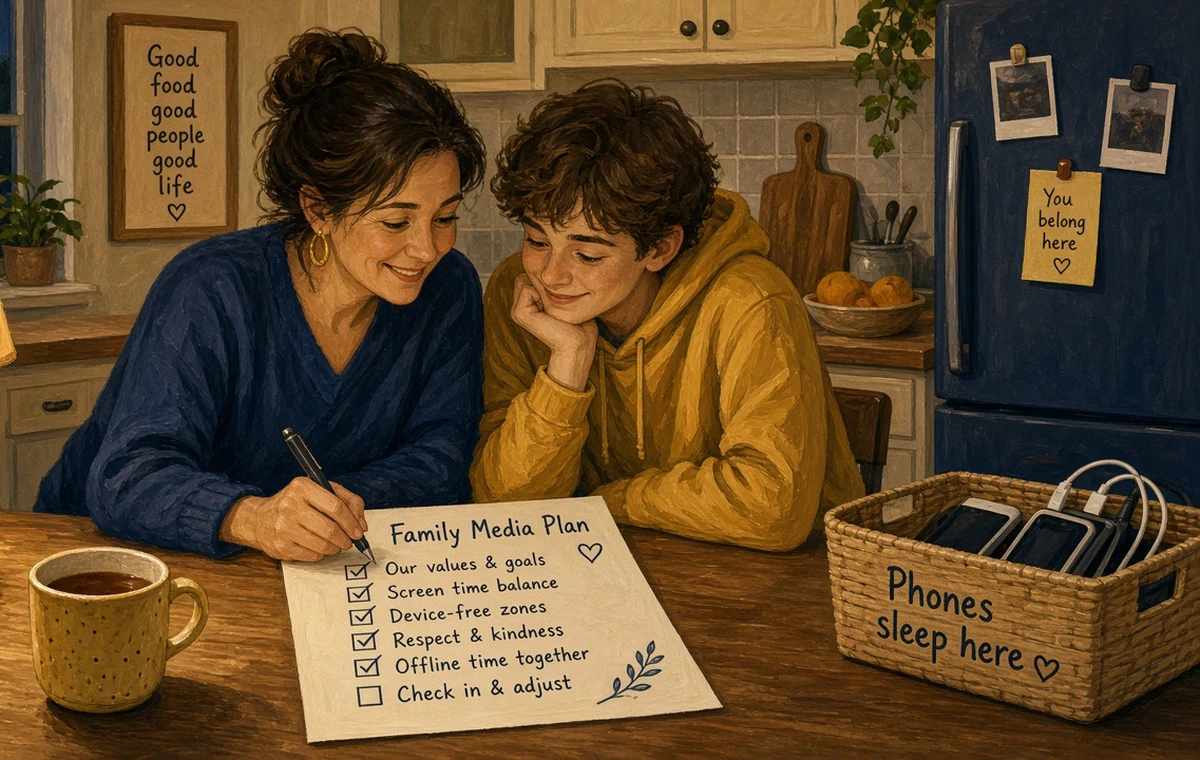
In the US, the American Academy of Pediatrics moved away from a single screen-time number years ago. Instead it recommends a Family Media Plan, a free online tool that helps each family decide together on screen-free zones such as bedrooms and the dinner table, screen-free times such as the hour before bed, and how media fits around sleep, exercise and homework. The 2023 US Surgeon General advisory on social media and youth mental health reinforced that message.
In the UK, the Online Safety Act 2023 places legal duties on platforms. Ofcom's children's safety codes, in force since July 2025, require services likely to be used by children to carry out risk assessments, use effective age checks for the most harmful content and tame algorithms that push harmful material to young users. The law does not set screen-time limits, but it shifts part of the responsibility from parents to the companies that design the feeds.
| Area | United States | United Kingdom |
|---|---|---|
| Family guidance | AAP Family Media Plan, Surgeon General advisory | NHS and UK Chief Medical Officers' screen-use advice |
| Platform regulation | COPPA protects under-13s' data; state laws vary | Online Safety Act 2023 with Ofcom children's codes |
| Specialist treatment | Hospital and private programs; insurance coverage varies | NHS National Centre for Gaming Disorders in London, free on referral |
Put simply, American families rely more on guidance and private choices, while British families can lean on platform rules and a free national clinic. Either way, the day-to-day work still happens at home.
What happens at an NHS gaming disorder clinic?
The NHS National Centre for Gaming Disorders opened in London in 2019 as the first NHS service of its kind and accepts referrals from across England for people aged 13 and over. Treatment typically begins with a thorough assessment of gaming patterns, mood, sleep and family relationships.
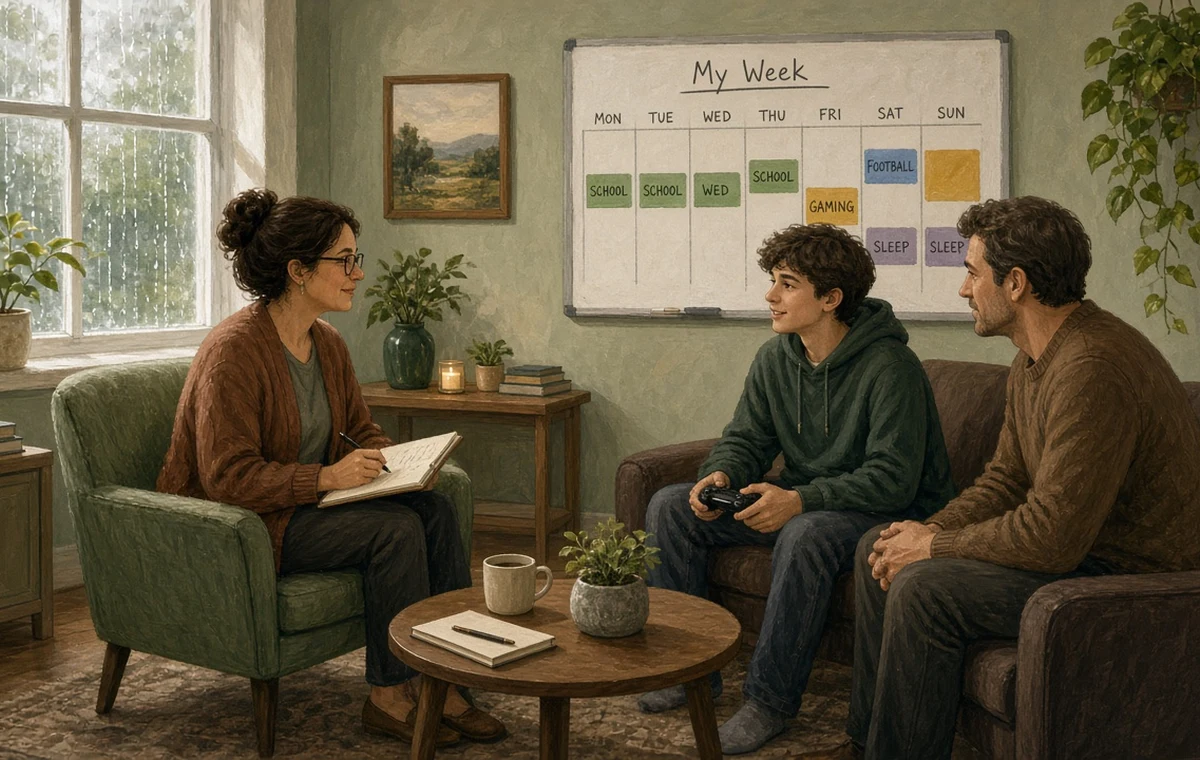
Most programs use cognitive behavioral therapy to identify triggers, challenge thoughts such as "I will lose my rank if I stop," and practice alternative ways of coping. Family sessions are central, because many conflicts come from mismatched expectations rather than the game itself. In the US, similar help is available through adolescent psychiatry clinics, therapists trained in CBT and a small number of specialist residential programs, with costs that depend on insurance.
How can families solve the problem step by step?
A problem-solving approach keeps the focus on the situation, not on blaming the teen. Each step can be revisited if the first plan does not work.
Student money tip on CampusDown Repair Up: Landlord repair request letter template you can copy.
- Define the problem together: track play time and its effects for a week, without lectures, so everyone sees the same facts.
- Look for causes: ask what the game gives them, whether that is friends, achievement, escape or stress relief.
- Brainstorm solutions: list several options, such as a curfew, gaming only after homework, weekend tournaments or a new offline activity with the same friends.
- Choose and write a screen contract: agree on specific limits, devices charging outside bedrooms and what happens if the agreement is broken.
- Try it, then review: meet again after two weeks, celebrate what worked and adjust what did not.
Parental controls on consoles and phones can support the plan, but they work far better as a shared tool than as a surprise lockout. If the teen's mood drops, school refusal sets in or attempts to cut back fail repeatedly, it is time to talk to a pediatrician or GP about specialist help.
Reference: Young, K. S. (1998). Caught in the Net: How to Recognize the Signs of Internet Addiction and a Winning Strategy for Recovery. John Wiley and Sons, an early and influential book on the warning signs of internet addiction and paths to recovery.
FAQ
How many hours of gaming is too much?
There is no single cutoff. ICD-11 looks at loss of control, gaming taking priority over other activities and continued play despite harm, rather than hours alone.
Is gaming disorder an official diagnosis?
Yes, in the WHO's ICD-11, which took effect in 2022. The US DSM-5-TR lists internet gaming disorder as a condition needing further study.
What is the AAP Family Media Plan?
It is a free online tool from the American Academy of Pediatrics that helps families agree on screen-free zones and times and on how media fits around sleep, school and exercise.
Does the UK Online Safety Act limit screen time?
No. It requires platforms to assess and reduce risks to children, including age checks for the most harmful content, but it does not set screen-time limits for families.
Who can get help at the NHS National Centre for Gaming Disorders?
People aged 13 and over in England can be referred, usually through a GP or other professional, and treatment is free on the NHS.