
Taylor's Scientific Management and Mayo's Human Relations Theory: How Do They Shape Nursing Management?
- Scientific management analyses tasks to find and standardise the most efficient way of working.
- Human relations theory grew out of the Hawthorne studies and showed that feelings and informal groups shape productivity.
- Good nurse managers combine standard procedures with attention to staff motivation, recognition and relationships.
Contents
Scientific management treats work as a set of tasks to be measured and standardised, while human relations theory treats it as a social activity shaped by feelings, recognition and group norms. Nursing management needs both. This guide compares Frederick Taylor and Elton Mayo, sets out where each falls short, and shows how ward staffing, quality programmes and leadership in the UK and US still carry their fingerprints.
Student money tip from CampusDown Life UpHow to Find Unclaimed Money in Your Name — How to find unclaimed money in your name for free: official state databases via NAUPA and MissingMoney.com, federal searches like Treasury…
Ask a ward manager whether the unit would run better if every task followed a fixed procedure, or if she focused first on how her nurses feel. Most will say "both", and that answer sums up a debate that began more than a century ago.
Why does nursing need management theory?
Nursing has to deliver safe, high-quality care with limited staff and resources. A nurse manager must raise efficiency while keeping people engaged and willing to stay, so she needs a framework for thinking about the organisation. Management thought developed from classical theories focused on structure and tasks, to human relations theories focused on people, to open systems and contingency theories focused on the organisation and its environment. Scientific management is where it starts.

What did Taylor propose?

In The Principles of Scientific Management (1911), Frederick Winslow Taylor argued that rule-of-thumb methods wasted effort and that careful analysis could find "one best way" to do each job, benefiting both workers and owners. His best-known example came from loading pig iron at Bethlehem Steel. The wiki entry on scientific management summarises his principles:
- Use time and motion study to analyse work and standardise the most efficient method.
- Select and train the right person for each job scientifically.
- Motivate with a differential piece rate that pays more for higher output.
- Divide labour so that managers plan and workers carry out the plan.
Critics said Taylor treated people like parts of a machine. Workers resented the stopwatch, and the separation of thinking from doing left little room for skill or judgement.
Skimming the section headings first makes a long guide much easier to map out. Try writing down one question of your own as you read.
What did Mayo and the Hawthorne studies find?
Between 1924 and 1932, researchers at Western Electric's Hawthorne Works in Cicero, Illinois, changed lighting levels, rest breaks and working hours to see how output responded. Output often rose even when conditions got worse. In the relay assembly test room, a small group of women produced more as they gained attention, a say in their routine and a close working relationship. In the bank wiring room, men kept output to an informal group norm regardless of incentives.
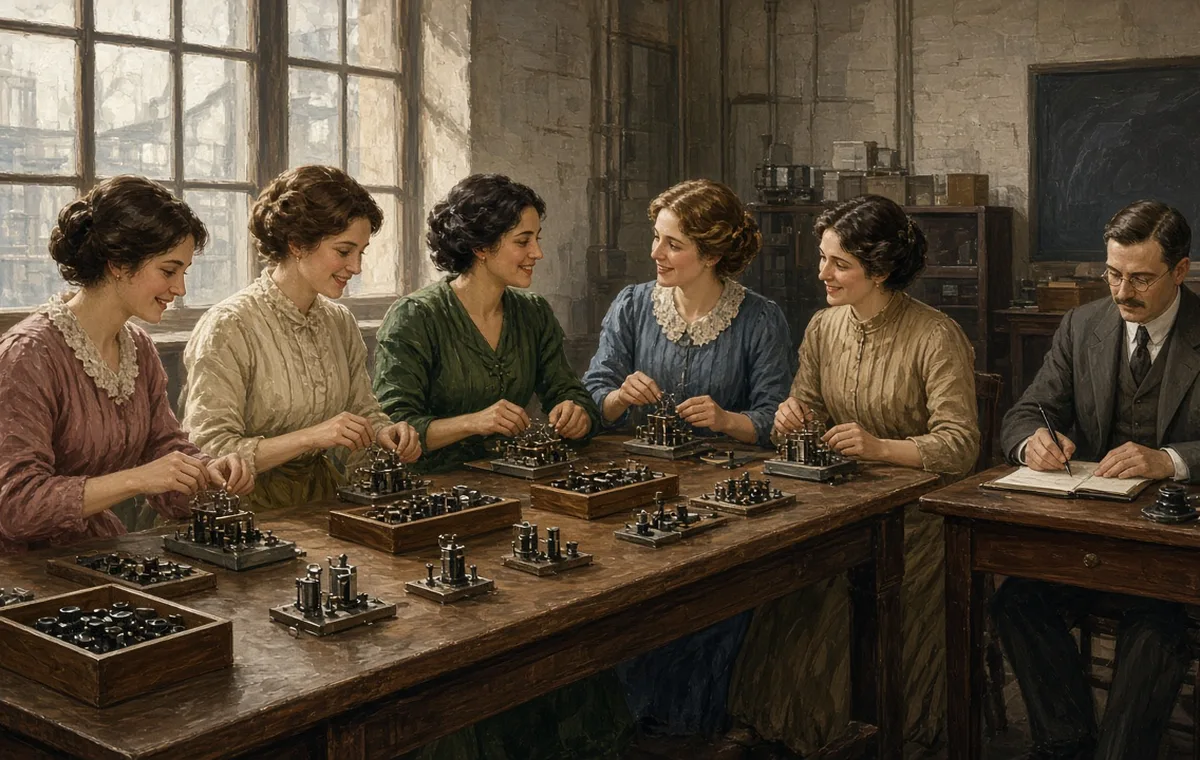
Elton Mayo and his Harvard colleagues interpreted these results as proof that social needs, morale and informal groups drive performance. The later term Hawthorne effect describes how people change their behaviour when they know they are being observed. Human relations theory put participation, communication and motivation at the centre of management, but it was criticised for neglecting organisational structure, the wider environment and conflict over pay.
How do the two theories differ?
| Aspect | Scientific management | Human relations |
|---|---|---|
| View of people | Respond to financial rewards | Have social and emotional needs |
| Focus | Formal structure, tasks, efficiency | Informal groups, morale, satisfaction |
| Motivators | Piece rates and bonuses | Recognition, participation, belonging |
| Main limitation | Ignores the human side | Ignores structure and environment |
They look like opposites, but real organisations need both efficient work and satisfied people, so it is more useful to treat them as complementary.
How are they used in nursing today?
Taylor's legacy shows in standard care procedures, checklists for infection control and staffing based on measured workload. The NHS programme Productive Ward: Releasing Time to Care, launched in 2007, used lean methods to cut wasted steps so nurses could spend more time with patients. NICE's 2014 safe staffing guideline for adult wards and acuity tools such as the Safer Nursing Care Tool put numbers on how many nurses a ward needs. In California, the law has set minimum nurse-to-patient ratios since 2004, such as one nurse to two patients in intensive care.

Mayo's legacy shows in efforts to reduce turnover and burnout through peer support, fair communication and shared decision-making. The ANCC Magnet Recognition Program, first awarded in 1994, makes transformational leadership and shared governance central to recognising hospitals with strong nursing cultures.
What came after Taylor and Mayo?
Most textbooks move next to systems theory, contingency theory and leadership theory. Systems theory treats a ward as inputs (staff, supplies, information), throughput (the nursing process), outputs (patient outcomes and satisfaction) and feedback. Contingency theory says there is no single best way to manage: the right approach depends on unit size, patient acuity and staff mix.
Leadership theory completes the picture. James MacGregor Burns described transformational leadership in Leadership (1978), and Bernard Bass developed it further. Unlike transactional leadership based on rewards and sanctions, it emphasises vision and individual development. Avedis Donabedian's 1966 framework of structure, process and outcome links neatly to systems theory and underpins much of today's quality assessment.
- Scientific management: standard procedures, task lists, supplies kept in fixed places
- Human relations: informal staff networks, morale, peer support
- Systems theory: quality improvement from inputs to patient outcomes
- Contingency theory: different staffing models in intensive care and general wards
- Transformational leadership: a ward manager who sets a vision and coaches each nurse
Where can you see these ideas on a placement?
Staffing models are the clearest example. Functional nursing, where one nurse does all the medications and another all the dressings, echoes Taylor's division of labour. Primary nursing, developed by Marie Manthey at the University of Minnesota in the late 1960s, gives one nurse responsibility for a small group of patients from admission to discharge, which fits the human relations focus on relationships and autonomy. Many wards use team nursing by day and add functional elements at night when staff are fewer, which is contingency theory in action.
Student money tip on CampusDown Life Up: How to Find Unclaimed Money in Your Name.
On your next placement, note how the ward divides work across shifts. That observation makes an excellent example linking theory to practice. CampusDown's nursing management notes include theory-to-practice tables you can use to check your structure.
Reviewed by the CampusDown editorial team, November 2026. References: Taylor, F. W. (1911). The Principles of Scientific Management. Harper & Brothers; Roethlisberger, F. J. & Dickson, W. J. (1939). Management and the Worker; Donabedian, A. (1966). Evaluating the quality of medical care. Milbank Memorial Fund Quarterly; Burns, J. M. (1978). Leadership.
FAQ
Are nursing protocols a product of scientific management?
In part. Standardising procedures to reduce variation and error follows Taylor's principle of finding one best method, although modern protocols are built on clinical evidence rather than time study alone.
What were the Hawthorne studies?
A series of experiments at Western Electric's Hawthorne Works near Chicago between 1924 and 1932. Researchers linked to Elton Mayo concluded that attention, group relationships and informal norms affected output more than physical conditions such as lighting.
Is scientific management still used?
Yes. Workload measurement, task standardisation, lean improvement programmes and performance targets all draw on its ideas.
Which comparison comes up most in nursing management exams?
The view of human nature, the main motivators and the limitations of each theory, often followed by which later theory addressed those limits.