
Short-Term, Sensory and Long-Term Memory: The Stage Model and Study Techniques That Work
- The information-processing model describes memory as encoding, storage and retrieval, moving from sensory to short-term to long-term stores.
- Sensory traces fade within seconds, and short-term memory holds only a few chunks unless information is rehearsed and given meaning.
- Chunking, spaced practice and self-testing beat rereading, as revision culture in the US and UK increasingly recognises.
Contents
Short-term memory is the stage that holds the information you are paying attention to for a few seconds, sitting between fleeting sensory memory and durable long-term memory; whether something survives depends on how much attention, repetition and meaning you give it. This guide explains the classic stage model of memory, how the three stores differ, which study techniques actually help, and how revision culture in the United States and the United Kingdom puts the theory to work.

Cognitive psychology covers memory, learning, consciousness and intelligence, and memory is usually the chapter students meet first. It is also the one they can test on themselves the same evening, which makes it ideal for an assignment linking theory to experience.
How does information become a memory?
The information-processing approach compares the mind to a computer. Information is encoded when a stimulus is turned into a form the brain can use, stored so that it lasts, and retrieved when we need it. The best-known version is the multi-store model proposed by Richard Atkinson and Richard Shiffrin in 1968, which describes a flow from sensory memory to short-term memory to long-term memory, with rehearsal keeping items alive along the way.
Student money tip from CampusDown Life UpHow to Find Unclaimed Money in Your Name — How to find unclaimed money in your name for free: official state databases via NAUPA and MissingMoney.com, federal searches like Treasury…
The source also notes a newer view in which memory is processed in many brain regions at once. That idea is usually linked to the connectionist or parallel distributed processing models popularised by David Rumelhart and James McClelland in 1986, and today most researchers treat the stage model as a useful map rather than a literal wiring diagram.

How are sensory, short-term and long-term memory different?
Sensory memory is the brief trace left by what you see, hear or feel, such as the sting of hot water. George Sperling's experiments in 1960 showed that a visual trace fades within about a second unless attention grabs it. Short-term memory is where attended information is held while you work with it; without rehearsal it typically fades within roughly twenty seconds.
Why is short-term memory so small?
George Miller's famous 1956 paper suggested people can hold about seven items, plus or minus two. Later work, notably Nelson Cowan's in 2001, put the true limit nearer four meaningful chunks, which is why chunking is so effective. Alan Baddeley and Graham Hitch added in 1974 that short-term memory is better seen as a working memory with separate parts for sounds, images and control.
| Store | What it holds | How long | What moves it on |
|---|---|---|---|
| Sensory memory | Raw sights, sounds and touch | Under a second to a few seconds | Attention |
| Short-term (working) memory | What you are actively thinking about | Seconds, unless rehearsed | Repetition and meaning |
| Long-term memory | Facts, events and skills | Potentially a lifetime | Retrieval keeps it accessible |
Long-term memory includes things we can describe, such as dates and stories, and skills we simply do, like a restaurant owner whose hands know the routine after years of repetition, which is the source's own example.
Skimming the section headings first makes a long guide much easier to map out. Try writing down one question of your own as you read.
Which study techniques actually work?
The source recommends three techniques: chunking information into meaningful groups, linking items through invented sentences, and turning words into pictures. Research adds two more that consistently top the evidence tables. Spaced practice means spreading revision over several sessions instead of cramming, and retrieval practice means testing yourself instead of rereading. Henry Roediger and Jeffrey Karpicke showed in 2006 that students who practised recalling a passage remembered more a week later than those who simply restudied it.

London's taxi drivers and the Knowledge
The most famous British memory test is the Knowledge of London, the exam licensed black-cab drivers must pass. Transport for London describes it as learning around 25,000 streets within six miles of Charing Cross, and candidates usually spend years riding routes on mopeds. In 2000 neuroscientist Eleanor Maguire and colleagues at University College London found that licensed drivers had a larger rear part of the hippocampus than comparison groups, a striking hint that intensive spatial learning can reshape the brain.
In the United States, the same principles drive flashcard apps and spaced-repetition software used for the SAT, medical licensing exams and language learning, while British GCSE and A-level students are routinely taught to make revision timetables, quiz themselves and use past papers rather than highlight textbooks.
| Item | Korea (source perspective) | United States | United Kingdom |
|---|---|---|---|
| High-stakes exam | Suneung and university coursework | SAT, AP and professional licensing exams | GCSEs, A-levels and the Knowledge for cab drivers |
| Popular technique | Chunking, association, picture memory | Flashcard and spaced-repetition apps | Revision timetables, self-quizzing, past papers |
| Research landmark cited | Information-processing model | Roediger and Karpicke's testing effect | Maguire's taxi-driver hippocampus study |
All three settings reward the same habit: pulling information out of memory at increasing intervals is far more powerful than pouring it in again.
What other memory ideas strengthen an assignment?
Several classic findings slot neatly into a report. Hermann Ebbinghaus, testing himself with nonsense syllables in 1885, plotted the forgetting curve that shows memory dropping fastest soon after learning. In 1975 Duncan Godden and Alan Baddeley had divers learn words underwater or on land, and they recalled more in the same setting, which is called context-dependent memory or encoding specificity.
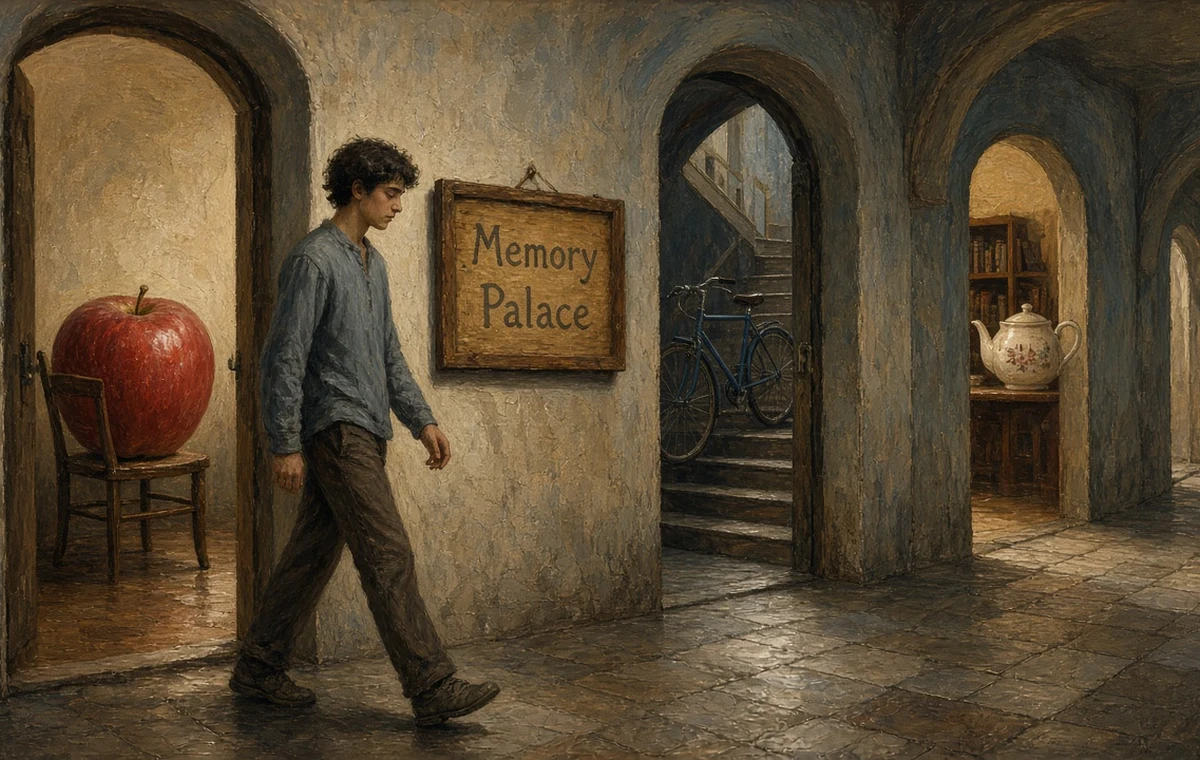
- Method of loci: place items along a familiar route, a trick traditionally credited to the Greek poet Simonides of Ceos
- Levels of processing: Fergus Craik and Robert Lockhart argued in 1972 that deeper, meaning-based processing lasts longer
- Tip-of-the-tongue: a retrieval block, not a storage failure, first studied by Roger Brown and David McNeill in 1966
One small correction to the source's conclusion is worth making. Mnemonics do not enlarge the capacity of short-term memory; they help by packing information into fewer, richer chunks and by giving retrieval better cues.
How should you structure an assignment on this topic?
Students most often stumble when they describe the three stores and then fail to say which stage their own experience belongs to. Try chunking twenty vocabulary words into four groups, check how many survive the next day, and report the result. Link the forgetting side of the story to the forgetting curve and the self-testing side to retrieval practice.
Student money tip on CampusDown Life Up: How to Find Unclaimed Money in Your Name.
Finish by treating forgetting as normal rather than as failure. The source's author says that accepting this, and swapping self-blame for technique, made studying far less stressful, which is a fair and very human conclusion.
Reviewed by the CampusDown editorial team, November 2026. Reference: Atkinson, R. C., and Shiffrin, R. M. (1968). Human memory: A proposed system and its control processes. In The Psychology of Learning and Motivation, Vol. 2.
FAQ
What is short-term memory?
The store that briefly holds information you are paying attention to, usually for seconds unless you rehearse it.
How many items can short-term memory hold?
Miller suggested about seven, plus or minus two, but later research puts the limit nearer four meaningful chunks.
What is the Knowledge of London?
The exam licensed black-cab drivers must pass, which Transport for London describes as learning around 25,000 streets within six miles of Charing Cross.
Is cramming or spaced revision better?
Cramming can work for the next morning, but spacing revision over several sessions leads to much better long-term recall.
Why does a word get stuck on the tip of my tongue?
The memory is still stored, but retrieval is temporarily blocked; a related cue or a short break often brings it back.