
How Do Korea's Medical Aid Type 1 and Type 2 Differ? Health Security, Eligibility, Referrals and Other Support
- Korea's health security has two pillars: National Health Insurance (social insurance) and Medical Aid (public assistance).
- Medical Aid Type 1 covers households unable to work, Type 2 households with someone able to work, and Type 1 pays less.
- Medical Aid is normally used in stages, starting with a primary-level clinic.
Contents
In Korea, Medical Aid Type 1 covers households in which nobody is able to work, such as children, people aged 65 and over and people with severe disabilities, and it charges almost nothing for inpatient care and very little for outpatient visits; Type 2 covers low-income households that include someone able to work, and asks for higher co-payments. What happens when a family that can barely cover rent is suddenly faced with a surgery bill? Korea has universal national health insurance, but for households too poor even to pay premiums, the state also runs Medical Aid, which pays medical costs directly from tax revenue. Knowing how the system is built, and how Type 1 and Type 2 differ, helps students explain it clearly and helps families avoid missing support they are entitled to.
How is Korea's health security system organised?
Health security protects people from the cost of illness and the income lost while they are ill. Korea's system has two pillars. National Health Insurance is a social insurance scheme: people pay contributions and receive benefits. Medical Aid is public assistance: tax revenue pays for the care of people on low incomes. The basic ideas behind the two pillars are explained under the principles of social insurance and the principles of public assistance.
Related on CampusDown Life UpHow Long to Keep Documents: Keep or Shred? — How long to keep tax records and household documents: the IRS's 3, 6 and 7-year rules, property records, papers to keep for life, and how…

Why can medical bills push a family into poverty?
Illness raises costs and cuts income at the same time: someone has to pay for treatment while the patient, and often a carer, cannot work. Without protection, a single operation can wipe out savings or force a family into debt. That is why most rich countries combine insurance for the majority with a tax-funded safety net for those who cannot pay in.
| Pillar | Type of scheme | Funding | Who it covers |
|---|---|---|---|
| National Health Insurance | Social insurance | Contributions from workers, employers and households, plus state support | Almost the whole population |
| Medical Aid | Public assistance | Tax revenue from central and local government | Low-income households and other designated groups |
The two Korean pillars differ in funding and in who they cover, but patients use the same hospitals and clinics. From the patient's side, what changes is the share of the bill they pay and the procedures they must follow.
Other countries draw the line differently. In the UK, the NHS is funded from general taxation and is largely free at the point of use, so there is no separate scheme like Medical Aid; the main costs left are things like prescriptions and dental care in England, with exemptions and the NHS Low Income Scheme for people on low incomes. In the US, Medicaid is the closest equivalent: a joint federal and state programme for people on low incomes, while Medicare covers most people aged 65 and over.

Who can receive Medical Aid?
The main group is households receiving Korea's National Basic Livelihood Security benefits that also meet the Medical Aid eligibility standard. Others are designated under separate laws, including disaster victims, people who rendered distinguished service to the state, and North Korean defectors. People covered by Medical Aid are taken out of National Health Insurance and do not pay health insurance contributions.
The income thresholds and amounts are revised by government notice every year, so anyone thinking of applying should check that year's standards directly at the community service centre for their address.
Skimming the section headings first makes a long guide much easier to map out. Try writing down one question of your own as you read.
How do Type 1 and Type 2 differ?
| Type | Main recipients | Key features |
|---|---|---|
| Type 1 | Households made up only of people unable to work (under 18, 65 and over, people with severe disabilities and others), plus people designated under other laws | Almost no charge for inpatient care; small outpatient co-payments |
| Type 2 | Low-income households that include someone able to work | Higher co-payments than Type 1 |
Two households can both receive basic livelihood benefits and still fall into different types, depending on whether anyone in them can work. The exact co-payment depends on the kind of medical institution and the treatment, so it is worth checking before treatment. When comparing the two types in an essay, set out the eligibility rules and the co-payment difference side by side, then explain the policy intent: the split is designed with work incentives in mind.
What is the step-by-step referral process?
Medical Aid is designed to be used in stages, starting with primary care.
- See a primary-level provider first, such as a local clinic or public health centre
- If needed, get a referral letter to a secondary hospital or general hospital
- With a further referral, move on to a tertiary (advanced general) hospital
- Emergencies, childbirth and certain conditions are exceptions and can go straight to a higher-level hospital
Using a higher-level hospital without a referral can mean the cost is not covered, so following the steps matters. The process is meant to make sure specialist care goes to those who need it, and nurses and hospital administrators can save patients cost and confusion by explaining it in advance.
Medical Aid also has tools that shape how it is used. An out-of-pocket ceiling stops costs piling up for people in long treatment. A cap on outpatient days means recipients who use services very often must get an extension approved, which aims to cut duplicate use but has been criticised as a burden on older people with several chronic conditions. Type 1 recipients receive a small monthly health maintenance allowance to spend on outpatient co-payments, and some recipients who use services very heavily are asked to register with one chosen clinic for most of their care.
| Feature | What it does | Angle for an essay |
|---|---|---|
| Out-of-pocket ceiling | Limits total co-payments over a period | Adds depth to the Type 1/Type 2 comparison |
| Outpatient day limit | Requires approval to extend very high use | Weighs efficiency against access |
| Health maintenance allowance | Monthly support for Type 1 outpatient costs | An example of an incentive design |
| Near-poor co-payment relief | Lower co-payments for some low-income insured people | Shows how gaps between schemes are filled |
Rules such as the outpatient day limit and the allowance amounts have been revised several times, so an essay should cite the current year's guidance from Korea's Ministry of Health and Welfare rather than older figures.
What help is there for people who do not qualify?
Also on CampusDown Life Up: How Long to Keep Documents: Keep or Shred?
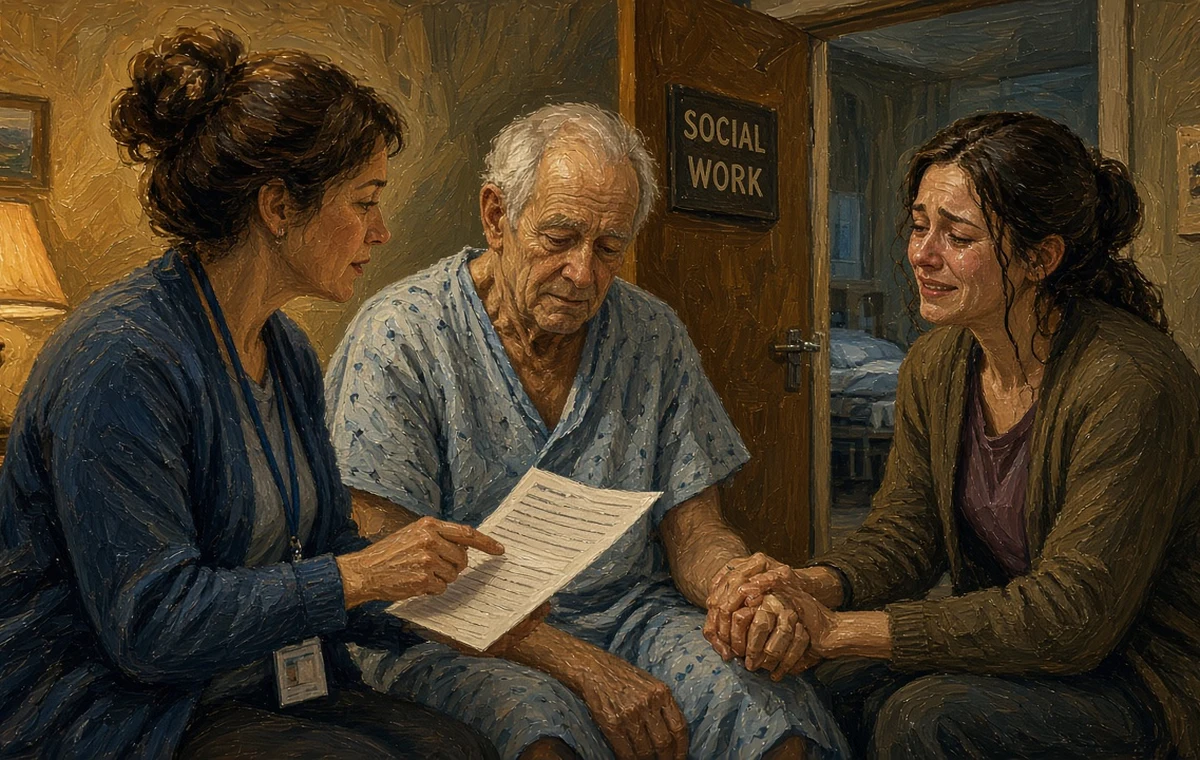
Why does the hospital social worker matter so much?
Households that do not qualify for Medical Aid but face medical costs far beyond their means can look at public schemes such as Korea's catastrophic medical expense support and emergency welfare medical support. Foundations and the Community Chest of Korea help with treatment costs for patients with rare diseases or childhood cancer. In most hospitals it is the medical social worker who knows these resources and connects families with them.
Money problems can quickly lead to treatment being abandoned and to a family's livelihood collapsing, so spotting financial strain early in an admission and referring the family to the social work team is one of the most practical ways to help. In the US, non-profit hospitals must have a written financial assistance policy, often called charity care, and asking for it can reduce or cancel a bill.

Taken together, these tools show Medical Aid as a system trying to balance protection with efficiency. Grouping them into measures that ease the burden and measures that manage use is a good way to structure the conclusion of an essay, and comparing them with Medicaid or NHS exemptions shows how different countries handle the same problem.
Compiled by the CampusDown editorial team from a Korean article on Korea's Medical Aid Type 1 and Type 2, adapted with public information on NHS charges and the NHS Low Income Scheme in England, and Medicaid, Medicare and non-profit hospital financial assistance rules in the US. Source: Medical Aid Act (Republic of Korea), Korea Law Information Center, https://www.law.go.kr. Reviewed November 2026. This is general information, not legal or financial advice; check current rules with the relevant agency.
FAQ
Do Medical Aid recipients pay health insurance contributions?
No. People covered by Medical Aid are removed from National Health Insurance and do not pay contributions.
Where do you apply for Medical Aid in Korea?
At the community service centre for your address, usually together with an application for basic livelihood benefits.
Can someone move from Type 2 to Type 1?
Yes. If a household member's ability to work or the household make-up changes, a review can change the type.
Is Korea's Medical Aid like Medicaid in the US?
Both are tax-funded health cover for people on low incomes, but Korea's is tied to the national basic livelihood system and works alongside universal health insurance.
What if I don't qualify but can't afford treatment?
Ask the hospital's medical social worker about catastrophic medical expense support, emergency welfare support and charitable funds.