
How to Make Early Childhood Inclusion Work: Special Needs Definitions, Forms of Inclusion and Team Roles
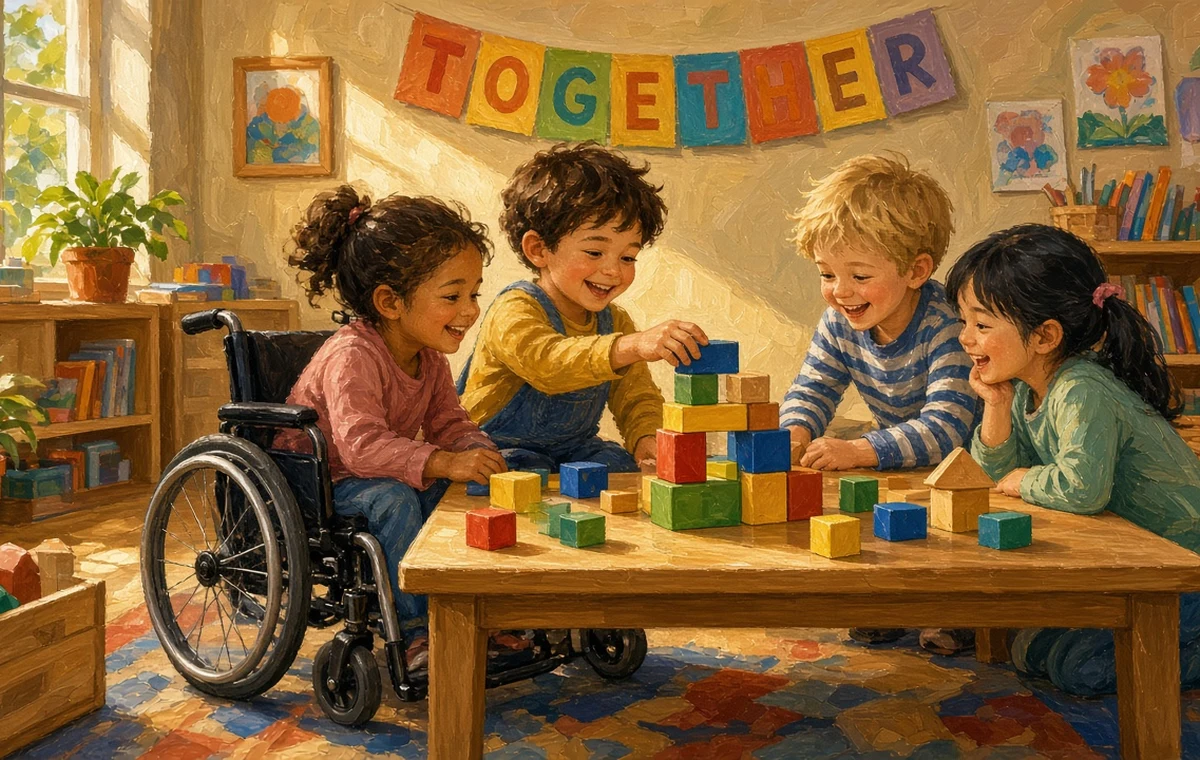
- Inclusion means children with and without disabilities learning together with support.
- Definitions, history and the four forms of inclusion frame the assignment.
- Teamwork and individual plans turn inclusion into daily practice.
Contents
Inclusive education means children with and without disabilities learn in the same setting, with the support each child needs provided there rather than elsewhere. Early childhood is when social skills and language grow fastest through play with peers, so whether inclusion works in nurseries and preschools matters a great deal. This guide, adapted from a Korean early childhood special education study note, covers how children with special needs are defined, how inclusion developed, the forms it takes, the teamwork that makes it work, where students go wrong in assignments, and how the United States and the United Kingdom organise early years inclusion.
Why does inclusion matter in early childhood?
Related on CampusDown Law UpAsking for Disability Accommodations in College for the First Time — ADHD, anxiety, a chronic condition, or an injury?
Young children learn to share, take turns, negotiate and talk mostly through play with other children. A child with a disability who spends the day apart from peers loses many of those chances, while children without disabilities lose the chance to grow up treating difference as ordinary.
Inclusion is not simply placing children in the same room. It means adapting activities, spaces and support so that every child can take part in the day's routines and play in a meaningful way.

How are children with special needs defined?
Definitions differ between law and academic writing. In general, a child with special educational needs is one whose physical, intellectual, emotional or communication characteristics differ from peers enough to need specific educational support. Academic writing on exceptional children often includes gifted children too.
| Source | Focus | Includes gifted children? |
|---|---|---|
| Korean special education law | Listed disability categories that qualify for special education services | No, gifted education has a separate law |
| Academic usage (exceptional children) | Any child whose needs differ markedly from peers | Often yes |
| Social model view | Barriers in the environment, not only the child | Not the focus |
One clarification to the source: under Korea's Act on Special Education for Persons with Disabilities, enacted in 2007, gifted children are not special education students; they are covered by a separate gifted education law. When you quote a legal definition, check the current text of the statute rather than a textbook summary, and set it next to the academic definition to show that definitions are relative to purpose.
Skimming the section headings first makes a long guide much easier to map out. Try writing down one question of your own as you read.
How did inclusive education develop?
The normalisation principle took shape in Scandinavia, first in Denmark at the end of the 1950s and then, in a fuller form, in Sweden in the late 1960s. It argued that people with disabilities should live under conditions as close as possible to those of everyone else. The idea fed into the mainstreaming movement in the United States and the principle of the least restrictive environment, written into federal law in 1975. The wiki entry on the normalization principle and inclusive education traces the history.
| Form | How it works | Main trade-off |
|---|---|---|
| Full inclusion | The child spends the whole day in the general class with support | Needs strong in-class support |
| Itinerant teacher | A special education teacher visits and supports the class | Support is limited to visit times |
| Special class | A separate class within the same setting | Less contact with peers |
| Part-time inclusion | The child joins the general class for set periods | Transitions can be hard for the child |
A good assignment compares the forms by how much time the child spends with peers, who provides support, and what each form demands from staff.
What do early childhood settings need?

The source study puts teamwork at the centre: the setting's director, the special education teacher and the general class teacher need to coordinate. It reports that staff are generally willing to work together but feel left out of decisions and short on training and administrative support. Seeing disability as a matter of environmental barriers rather than only individual impairment, as explained in the wiki entry on the medical and social models of disability, helps shift attention to what the setting can change.
| Role | Main tasks |
|---|---|
| Director | Staffing, training time, links with local services and families |
| Special education teacher | Individual plans, adapting activities, coaching class staff |
| Class teacher | Daily routines, peer interaction, observation notes |
| Parents | Information about the child, shared goals at home |
Proposals such as more training, stronger administrative support and a regular channel with parents become practical when you state who does what and when, and link them to the child's individualised education plan.
Where do students get stuck?
The hardest part is connecting theory to practice. Common mistakes are describing inclusion as simply sharing a room, getting law names or dates wrong, and describing children with disabilities only in terms of deficits. For example, a student could take a placement setting's daily timetable, mark the times a disabled child finds hard to join, and write the support and responsible staff member for each slot in an individual plan format. Check that you verified the legal definition, compared the four forms, divided team roles, linked proposals to an individual plan and wrote from the child's strengths.
How do the US and UK organise early years inclusion?
United States
The Individuals with Disabilities Education Act, which began as the Education for All Handicapped Children Act in 1975, guarantees a free appropriate public education in the least restrictive environment. Infants and toddlers receive early intervention under an Individualized Family Service Plan, and from age three children can receive preschool special education under an Individualized Education Program. Head Start programmes must make places available for children with disabilities, and a 2009 joint position statement from the Division for Early Childhood and NAEYC set out a shared definition of early childhood inclusion.
United Kingdom
In England, the Children and Families Act 2014 and the SEND Code of Practice cover children and young people from birth to 25. Early years settings are expected to have a special educational needs coordinator and to follow a graduated approach of assess, plan, do and review, and children with more complex needs can receive an Education, Health and Care plan. The Equality Act 2010 also requires reasonable adjustments so that disabled children are not put at a disadvantage.
| Item | United States | United Kingdom (England) |
|---|---|---|
| Main law | IDEA (from 1975) | Children and Families Act 2014, SEND Code of Practice |
| Individual plan | IFSP under 3, IEP from 3 | Graduated support, EHC plan for complex needs |
| Key principle | Least restrictive environment | Assess, plan, do, review; reasonable adjustments |
Comparing these systems with Korea's shows a shared direction: support follows the child into ordinary settings, and individual plans turn good intentions into concrete actions.
How should you write an inclusion assignment?
A clear structure is: the definition of children with special needs, the history and principles of inclusion, the four forms compared, the collaboration system, and practical proposals linked to an individual plan. In the conclusion, name one thing you would prepare first as a teacher in an inclusive class.
Also on CampusDown Law Up: Asking for Disability Accommodations in College for the First Time.
Support systems differ by region, so check guidance from your local education authority or council. Write about children in terms of their strengths and the barriers around them, not only what they cannot do.
- Inclusion means learning together with support, not just sharing a room.
- Legal and academic definitions of special needs differ, especially on gifted children.
- Normalisation led to mainstreaming and the least restrictive environment.
- Teamwork among director, special and class teachers is the core.
- The US uses IFSPs and IEPs; England uses SENCOs and EHC plans.
FAQ
What is inclusive education in early childhood?
Children with and without disabilities learn and play in the same setting, with the support each child needs provided there.
Are gifted children special education students?
In academic writing on exceptional children they often are, but under Korean special education law they are covered by a separate gifted education law.
What is the least restrictive environment?
The principle that children with disabilities should be educated with non-disabled peers as far as appropriate, written into US law in 1975.
What are the four forms of inclusion?
Full inclusion, itinerant teacher support, a special class within the setting, and part-time inclusion.
Who should be on an inclusion team?
The director, the special education teacher, the class teacher and the child's parents, each with clear tasks.