
How Does HIV Weaken the Immune System? CD4 Cells, the Viral Life Cycle and How Modern Antiretroviral Treatment Works
- HIV hijacks CD4 helper T cells, and untreated infection can progress to AIDS.
- Combination therapy blocks several steps of the viral life cycle and is now advised for everyone diagnosed.
- A durably undetectable viral load means HIV is not passed on through sex (U=U).
Contents
Why do people living with HIV take a combination of medicines rather than a single drug? The answer lies in how the virus copies itself inside the body's immune cells. This guide explains how HIV targets CD4 cells, what happens at each stage of its life cycle, how modern antiretroviral therapy (ART) blocks those stages, and how testing, treatment and prevention are organised in the United States and the United Kingdom today.
What is the difference between HIV and AIDS?
HIV, the human immunodeficiency virus, is the infection. AIDS, acquired immunodeficiency syndrome, is the most advanced stage of untreated HIV, diagnosed when the CD4 count falls below 200 cells per cubic millimetre of blood or when certain AIDS-defining illnesses appear. With today's treatment, most people diagnosed with HIV never reach that stage.
Student money tip from CampusDown Law UpI Found Bed Bugs in My Apartment. Who Has to Deal With It? — Bed bugs and landlord responsibility depend on your state and lease.
| Feature | HIV-1 | HIV-2 |
|---|---|---|
| Where it is found | Worldwide; the cause of most infections | Mainly West Africa and countries with links to the region |
| Course without treatment | Progresses faster on average | Usually progresses more slowly and is less easily transmitted |
| Treatment notes | All main drug classes are active | Naturally resistant to NNRTIs and the entry inhibitor enfuvirtide, so regimens are chosen differently |
Knowing which type someone has matters in practice, because a medicine that works well against HIV-1 can be useless against HIV-2. Laboratories therefore confirm the type during diagnosis, and specialist clinics choose drug combinations with that result in mind before treatment begins.

How does HIV copy itself inside a cell?
HIV is a retrovirus: its genes are stored as RNA, and it must turn that RNA into DNA and splice it into the host cell's own genome before it can multiply. Like other viruses, it cannot reproduce on its own and hijacks the cell's machinery instead.
| Step | What happens | Drug class that acts here |
|---|---|---|
| 1. Binding and fusion | The virus attaches to the CD4 receptor and a co-receptor, then fuses with the cell membrane | Entry and attachment inhibitors |
| 2. Reverse transcription | Viral RNA is copied into DNA | NRTIs and NNRTIs |
| 3. Integration | Viral DNA is inserted into the cell's chromosomes | Integrase inhibitors (INSTIs) |
| 4. Assembly and maturation | New viral proteins are cut to size and packaged | Protease inhibitors (PIs) |
| 5. Release | New virus particles bud from the cell to infect others | Capsid inhibitors act at several late and early steps |
Integration is also why HIV cannot yet be cured. Some infected cells fall into a resting state, carrying silent viral DNA that medicines cannot reach. This hidden pool, called the latent reservoir, reactivates if treatment stops, which is why therapy is lifelong for now.
Skimming the section headings first makes a long guide much easier to map out. Try writing down one question of your own as you read.
Why are CD4 cells so important?
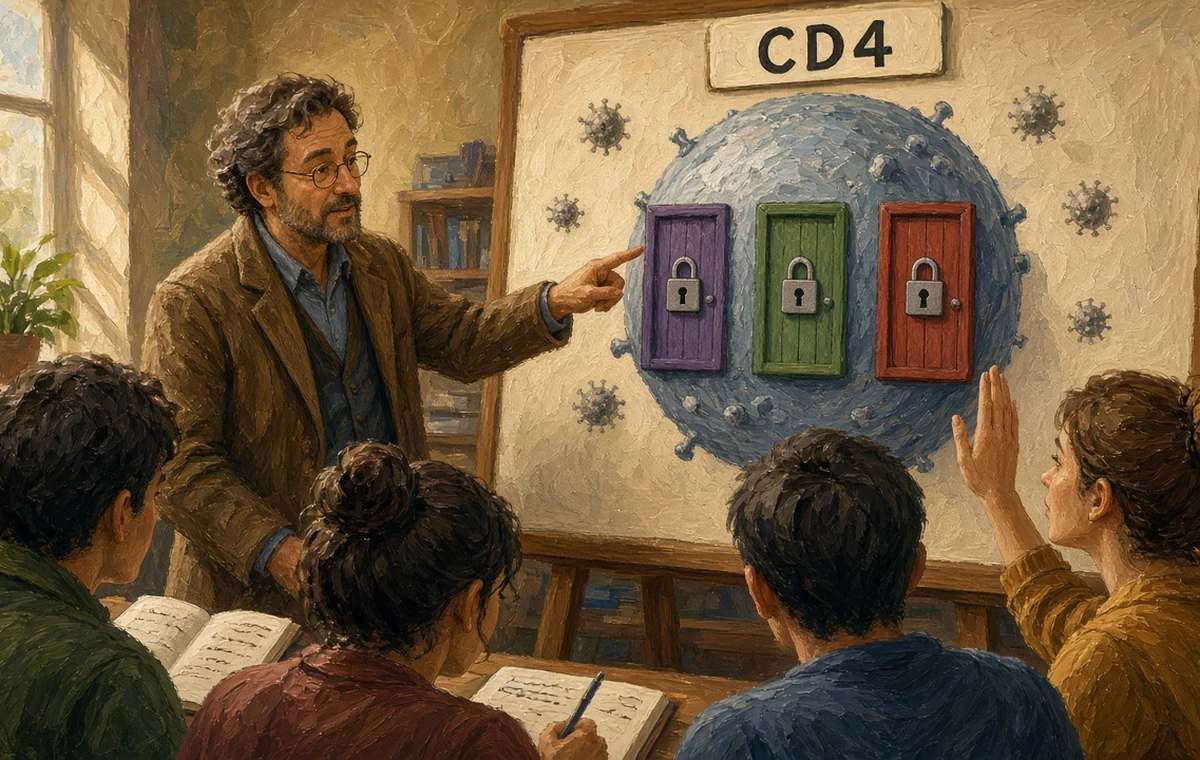
CD4 T cells, often called helper T cells, act like the conductors of the immune system. They signal B cells to make antibodies and help killer T cells destroy infected cells. When untreated HIV slowly depletes them, the whole orchestra loses its timing. Infections that a healthy body controls easily, such as Pneumocystis pneumonia, and certain cancers, such as Kaposi sarcoma, then take hold. These are known as opportunistic infections.
A blood test that counts CD4 cells shows how strong the immune system currently is, while a viral load test shows how much virus is circulating. Both numbers are tracked throughout care, but they answer different questions, which the next sections explain.
How does modern HIV treatment work?
Antiretroviral therapy combines medicines that hit the virus at different steps, so that a strain resistant to one drug is still stopped by another. The goal is to push the viral load so low that standard tests cannot detect it.
The source suggested that the CD4 count decides when to start treatment, which is now outdated. Since the START trial and WHO guidance in 2015, treatment is recommended for everyone diagnosed with HIV as soon as possible, whatever their CD4 count. The CD4 count is still used to judge immune recovery and to decide whether preventive antibiotics against opportunistic infections are needed. Treatment has also become much simpler: many people take a single tablet once a day, some take a two-drug regimen, and long-acting injections given every one or two months are approved in a number of countries.

The most important message is U=U, undetectable equals untransmittable. Large studies such as HPTN 052, PARTNER and PARTNER2 found no sexual transmission from partners whose viral load was durably undetectable on treatment. This is now an established scientific consensus, endorsed by the CDC, WHO and UK health bodies, not a provisional finding. U=U does not protect against other sexually transmitted infections, and advice on breastfeeding is handled separately with a clinician.
With early diagnosis and steady treatment, people living with HIV can expect a life expectancy close to that of the general population. Stopping and restarting medicines, on the other hand, lets the reservoir rebound and can breed drug resistance, so long-term support with adherence is part of good care rather than an optional extra.
How do the US and UK organise HIV care?
United States
The CDC recommends that everyone aged 13 to 64 be tested for HIV at least once as part of routine health care, and more often for people at higher risk. Free and confidential testing is offered by many local health departments and community clinics, and self-test kits are sold in pharmacies. The Ryan White HIV/AIDS Program, created in 1990, funds medical care, medicines and support services for people with low incomes or without adequate insurance. PrEP is covered by most private insurance plans without cost sharing as a preventive service, and the national Ending the HIV Epidemic initiative focuses on areas with the most new diagnoses.
United Kingdom
In the UK, HIV testing and treatment are free through the NHS, regardless of immigration status, and sexual health clinics offer confidential walk-in testing. PrEP has been routinely available free of charge from sexual health services in England since 2020. England's HIV Action Plan aims to end new HIV transmissions by 2030, and opt-out HIV testing in emergency departments in areas of high prevalence has identified many people who did not know they had the virus.
| Item | United States | United Kingdom |
|---|---|---|
| Routine testing advice | At least once for ages 13 to 64 | Opt-out testing in many settings, including some emergency departments |
| Where to test | Health departments, community clinics, pharmacies, home kits | NHS sexual health clinics, GP surgeries, free home kits in many areas |
| Paying for treatment | Insurance, Medicaid, Medicare and the Ryan White program | Free through the NHS |
| National goal | Ending the HIV Epidemic initiative | End new transmissions in England by 2030 |
Both countries now treat HIV as a manageable long-term condition rather than a death sentence, and both stress that discrimination and fear keep people away from testing. Making testing routine, free and confidential is the single most effective way to find infections early and start treatment.
How can HIV be prevented, and what do the red ribbon and World AIDS Day mean?
HIV is fragile outside the body and is not passed on through everyday contact such as hugging, sharing cups or toilets, swimming pools or mosquito bites. It spreads through specific body fluids, mainly during sex without protection, through shared injecting equipment, and from parent to child if the parent is not on treatment.
Student money tip on CampusDown Law Up: I Found Bed Bugs in My Apartment. Who Has to Deal With It?.
| Method | How it works | Key point |
|---|---|---|
| Condoms | Physical barrier | Also protect against other sexually transmitted infections |
| PrEP | HIV-negative people take medicine before possible exposure | Daily tablets are standard; long-acting injections are approved in some countries |
| PEP | Medicine started after a possible exposure, including needlestick injuries | Start as soon as possible and within 72 hours; usually taken for 28 days |
| Treatment as prevention | A durably undetectable viral load | No sexual transmission (U=U) |
| Testing | Knowing your status | Allow for the window period and retest if the exposure was recent |

The red ribbon was created in New York in 1991 by the Visual AIDS artists' group and became widely known after it was worn at the Tony Awards that year. World AIDS Day has been held on 1 December every year since 1988 to remember those who have died, support people living with HIV and call for an end to stigma. Wearing the ribbon is a simple way to show that HIV is a health issue, not a moral judgement.
- HIV is the virus; AIDS is the advanced stage of untreated infection.
- Treatment is recommended for everyone diagnosed, regardless of CD4 count.
- Undetectable means untransmittable through sex.
- PEP must start within 72 hours of a possible exposure.
- Free, confidential testing is the gateway to all of the above.
FAQ
Is the CD4 count used to decide when to start treatment?
Not any more. Treatment is advised for everyone diagnosed; the CD4 count now tracks immune recovery and guides preventive antibiotics.
Do HIV medicines have to be taken for life?
For now, yes. Silent virus in the latent reservoir returns if treatment stops, although regimens have become much simpler.
Is HIV-2 treated the same way as HIV-1?
Not exactly. HIV-2 is naturally resistant to NNRTIs and enfuvirtide, so specialists choose other drug combinations.
Can mosquitoes or everyday contact spread HIV?
No. HIV is not passed on by mosquitoes, hugs, shared cups, toilets or swimming pools.
What should I do after a possible exposure?
Seek PEP from a clinic or emergency department as soon as possible, ideally within hours and no later than 72 hours.