
The Great Learning's Eight Steps Explained: Investigating Things, Zhu Xi vs Wang Yangming and Career Planning
- The Great Learning sets out eight steps from investigating things to bringing peace to the world.
- Zhu Xi read investigation as studying principle in things; Wang Yangming read it as correcting the mind.
- Mapped onto research, honest reflection, skill building and contribution, the steps make a practical career plan.
Contents
The Great Learning, one of Confucianism's Four Books, lays out eight steps that lead from investigating things and extending knowledge, through sincerity, a rectified mind and self-cultivation, to ordering the family, governing the state and bringing peace to the world. Zhu Xi read the first step as studying the principle in external things; Wang Yangming read it as correcting the mind. Both readings make a surprisingly practical framework for planning a career. This guide explains the text, its two great interpretations and how to turn them into a strong philosophy presentation.

Many students have heard the phrase "cultivate yourself, order your family, govern the state, bring peace to the world" without knowing what comes before it. The answer is a short ancient text that Western readers have known since the nineteenth century, and Ezra Pound even published his own version, Ta Hio, in 1928.
What kind of book is the Great Learning?
The Great Learning began as a chapter of the Book of Rites. The Cheng brothers of the Song dynasty raised its status, and Zhu Xi grouped it with the Analects, the Mencius and the Doctrine of the Mean as the Four Books, placing it first as the gateway to Confucian study. From 1313 the Yuan court based the civil service examinations on the Four Books with Zhu Xi's commentaries, which kept the text at the heart of education for six centuries.
Student money tip from CampusDown Repair UpIs a Small Leak Worth a Renters Insurance Claim? My Decision Checklist
The three guiding principles
The text opens with three principles: illuminating bright virtue, loving or renewing the people, and resting in the highest good. The middle one is a famous puzzle. The received text says qin min, "be close to the people", but Zhu Xi argued it should read xin min, "renew the people", while Wang Yangming defended the original wording. Mentioning this debate instantly lifts a presentation above summary. James Legge's 1861 English translation followed Zhu Xi and rendered it as renovating the people.

What are the eight steps?
The eight steps move outward like ripples on a pond, from the inner work of knowing to the public work of governing, and the text insists that each step depends on the one before it.
| Stage | Steps | Meaning |
|---|---|---|
| Knowing | Investigating things, extending knowledge | Explore the principles of things to perfect understanding |
| Heart and mind | Sincere intention, rectified mind | Be honest in intention and keep the mind balanced |
| Self | Cultivating the person | Refine one's own conduct |
| Society | Ordering the family, governing the state, peace under heaven | Extend good order outward to wider communities |
A note of caution: Zhu Xi attributed the commentary section to Confucius's disciple Zengzi, but modern scholars treat that authorship as traditional rather than proven, so phrase it carefully.
Skimming the section headings first makes a long guide much easier to map out. Try writing down one question of your own as you read.
How did Zhu Xi and Wang Yangming read "investigating things"?
Zhu Xi understood investigation as going to things and exhausting their principle. Because the original explanation of this step seemed lost, he wrote a short supplementary chapter: if you keep studying the principles of many things, one day everything suddenly connects. That is why reading and inquiry became the core method of Neo-Confucian learning.
Why did Wang Yangming fall ill staring at bamboo?
Wang Yangming, of the Ming dynasty, tells the story in his Instructions for Practical Living: as a young man he and a friend tried to investigate the principle of bamboo in the courtyard. The friend fell ill after three days and Wang after seven, with no insight at all. Later, during his exile at Longchang in 1508, he concluded that principle is not outside but in the mind, so investigating things means correcting what is not right in one's own thoughts. He went on to teach the extension of innate knowing and the unity of knowledge and action.
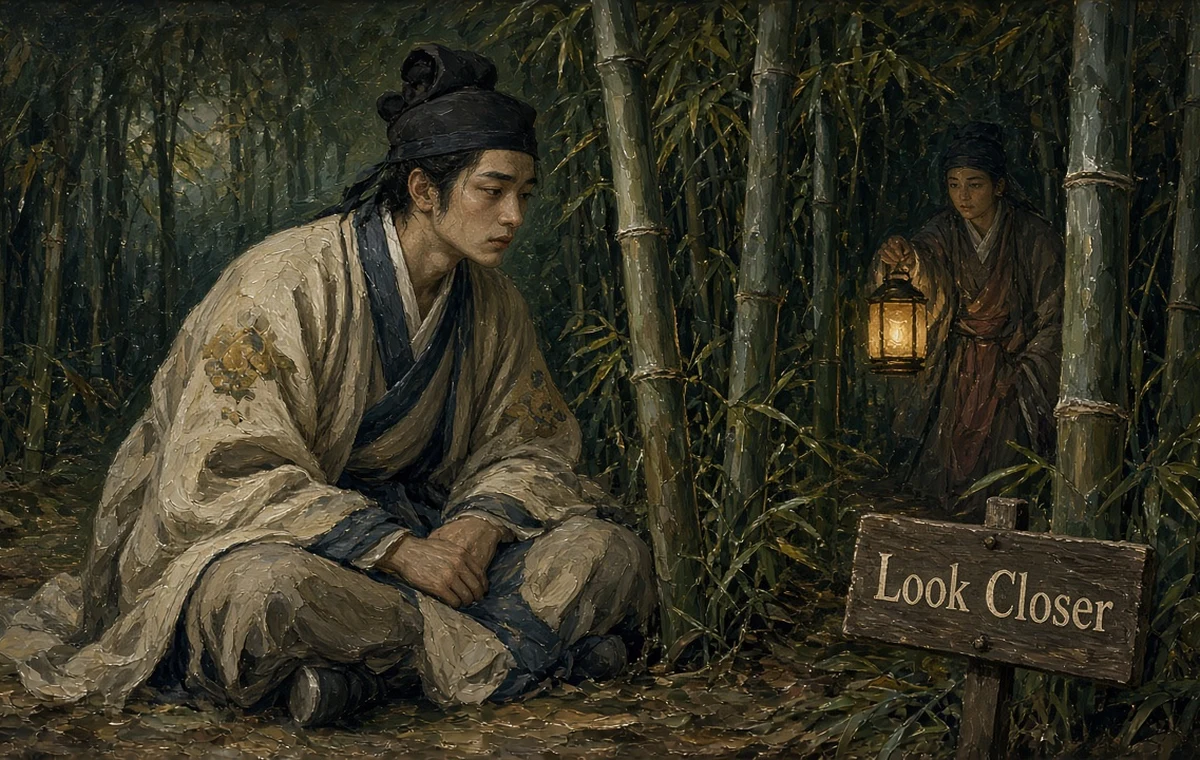
Comparing these two readings side by side is what turns a summary into an argument, because each implies a different method of learning.
How can the eight steps guide a career plan?
Here the ancient text becomes a surprisingly modern planning tool. Map each stage onto a concrete action, and give each one a deadline and a way to check progress.
- Investigating things and extending knowledge: research fields and jobs objectively. In the US, the Department of Labor's O*NET database lists tasks, skills and outlook for hundreds of occupations; in England, the National Careers Service offers job profiles and free advice.
- Sincerity and a rectified mind: face honestly what you actually want, not what sounds impressive.
- Cultivating the person: build the needed skills through steady practice, such as a course, a portfolio or an internship.
- Family, state and world: picture how your work will contribute to the people around you and to society.

Zhu Xi's reading suggests gathering broad information first; Wang Yangming's reminds you that no amount of data replaces knowing your own mind. A plan that uses both is more convincing than one that uses either alone.
| Aspect | Korea (source perspective) | United States | United Kingdom |
|---|---|---|---|
| Classical framing | Eight steps applied to career design | Usually taught through Western ethics instead | Usually taught through Western ethics instead |
| Job information | Researching job duties and required skills | O*NET occupational database | National Careers Service job profiles |
| Leadership link | Cultivate yourself, then lead others | Servant leadership | Servant leadership in management courses |
Showing how the same planning steps appear in different traditions helps your audience see why a two-thousand-year-old text is still worth discussing.
How should you structure the presentation?
Open with the familiar "cultivate, order, govern, pacify" line to hook the room, then cover the book and its three principles, the eight steps, the Zhu Xi and Wang Yangming debate, your own career application, and a conclusion. Put the original characters on one slide and explain them in plain English. For the full text of each step see the eight steps of the Great Learning, and to compare with modern theory see servant leadership, the approach Robert Greenleaf described in his 1970 essay The Servant as Leader.
Student money tip on CampusDown Repair Up: Is a Small Leak Worth a Renters Insurance Claim? My Decision Checklist.
The Confucian idea of cultivating yourself before leading others pairs naturally with leaders who serve their teams. Presenting Eastern and Western views together will also make the question and answer session much easier.
Reviewed by the CampusDown editorial team, November 2026. References: Zhu Xi, Daxue zhangju; Wang Yangming, Chuanxi lu (Instructions for Practical Living); Legge, J. (1861). The Chinese Classics, vol. 1.
FAQ
What does 'investigating things and extending knowledge' mean?
It is the first pair of the Great Learning's eight steps: exploring the principles of things in order to perfect one's understanding.
How did Zhu Xi and Wang Yangming differ?
Zhu Xi saw investigation as studying principle in external things through reading and inquiry; Wang Yangming held that principle lies in the mind, so investigation means correcting one's thoughts.
What is the bamboo story?
Wang Yangming recalled that he and a friend tried to find the principle of bamboo by staring at it; the friend fell ill after three days and Wang after seven.
Is the Great Learning available in English?
Yes. James Legge's 1861 translation is the classic version, and many modern translations exist.
Where can I research careers in the US or UK?
In the US, the O*NET database from the Department of Labor; in England, the National Careers Service website.