
Can Playing in the Woods Help Kids Talk Better? Forest Kindergartens, Forest School and Early Language
- Forest kindergartens offer a setting that changes daily and seasonally, which sparks curiosity and conversation with peers.
- Group play outdoors is linked with gains in language fluency, flexibility and originality.
- Forest activities also support self-esteem, emotional regulation and cooperation, from Danish woods to UK and US programs.
Contents
A forest kindergarten is an early-years setting where children aged roughly three to six spend most of the day outdoors in woods, meadows and streams, and research and practice suggest that this changing, unscripted environment gives children far more to talk about, more reasons to negotiate with friends and richer words to do it with. Put simply, a muddy stick can start a better conversation than a plastic toy, because nobody knows yet what it is going to become.
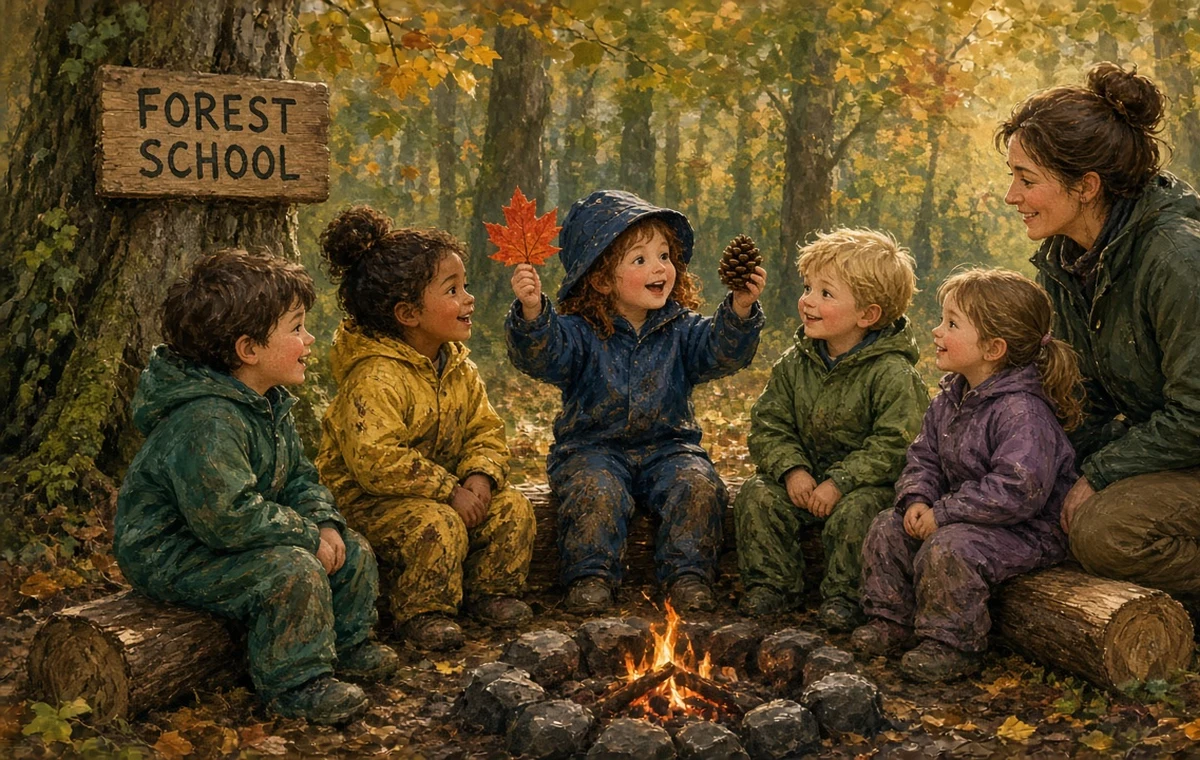
Parents often ask a fair question: if I want my child to speak well, should I read more picture books at home or send them out to roll in the leaves? This guide, adapted from a Korean study summary for English-speaking readers, explains why the two are not rivals, what forest settings actually do for speech, and how the idea grew from Scandinavia into UK Forest School sessions and licensed nature preschools in the United States.
Why does language matter so much in the early years?
Language is how a young child learns to say what they feel, understand what other people want and share an experience after it has happened. Between about three and six, children move from short phrases to telling stories with a beginning, a problem and an ending, and that leap depends heavily on how many real conversations they get to have. For an overview of the competing explanations, from Chomsky's built-in grammar to Vygotsky's social learning, see our wiki page on theories of language development.
Student money tip from CampusDown Repair UpIs a small leak worth a renters insurance claim? How to decide — compare the loss with your deductible, check who is responsible, and document it either way.
In England this priority is written into policy. The Early Years Foundation Stage treats Communication and Language as a prime area, with early learning goals for listening, attention and understanding, and for speaking. In the US, Head Start's early learning framework likewise treats language and communication as a core domain. Both expect children to learn talk through play rather than drills, which is exactly where outdoor settings shine.

Where did forest kindergartens come from?
The movement is usually traced to Denmark in the 1950s, when a mother named Ella Flatau began taking children into the woods each day and neighbors asked to join. Germany then turned the idea into a recognized model, the Waldkindergarten, with the first state-recognized one opening in Flensburg in 1993, and today there are well over a thousand across the country. The common thread is simple: no building as the main classroom, only shelter for the worst weather.
| Country | Common name | Typical format | What drives the language goals |
|---|---|---|---|
| Denmark and Germany | Skovbørnehave / Waldkindergarten | Full day, almost every day outdoors | National kindergarten curricula emphasizing play and self-direction |
| United Kingdom | Forest School | Regular sessions, often one morning a week, led by a trained Forest School leader | EYFS Communication and Language prime area |
| United States | Nature preschool / outdoor preschool | Half or full day; growing number of fully outdoor programs | State early learning standards and Head Start framework |
In the UK, staff from a Somerset college visited Danish settings in the early 1990s and brought the approach home, and the Forest School Association now sets out shared principles such as long-term, regular sessions in the same woodland and learner-led play with supported risk. In the US, Washington State became a pioneer by piloting a license for outdoor, nature-based child care from 2017 and later making that license permanent, so that programs with no main indoor classroom can operate legally.
Skimming the section headings first makes a long guide much easier to map out. Try writing down one question of your own as you read.
What makes the forest different from a classroom?
A classroom is designed to look the same on Monday and Friday. A forest is not. The stream is higher after rain, the path is crunchy in October and squelchy in March, and a fallen branch can be a horse, a bridge or a fishing rod by lunchtime. The Korean source makes the point that this lack of fixed structure is precisely the benefit: children constantly meet something new that needs a name, a description or an argument.
It also raises a quieter point about safety. Early-years teams rightly put safety first, but a setting with every risk removed can starve curiosity. UK Forest School leaders talk about risk-benefit assessment rather than risk elimination, and many US nature preschools use the same language. A low log to balance on, a cold stream to cross with a friend, a slope to climb: each is a small, managed challenge that children want to talk about afterwards.
How does forest play grow speaking skills?
In the woods children rarely play alone for long. Building a den, hunting for a beetle or deciding who is the troll under the bridge all require talk, and the Korean study summarized here links these group experiences with gains in three qualities of children's language.
- Fluency: how easily and how much a child can say without getting stuck.
- Flexibility: how well a child adapts words to the situation and the listener, for example explaining the same idea to a friend and to an adult.
- Originality: how often a child invents new expressions, comparisons and stories of their own.
Picture books still matter. Once a child has actually touched moss or heard a woodpecker, the words in the story are anchored to a memory, so there is more to say and more reason to say it. In practice the best programs combine both: a story read under a tree, then a hunt for the things that appeared in it.
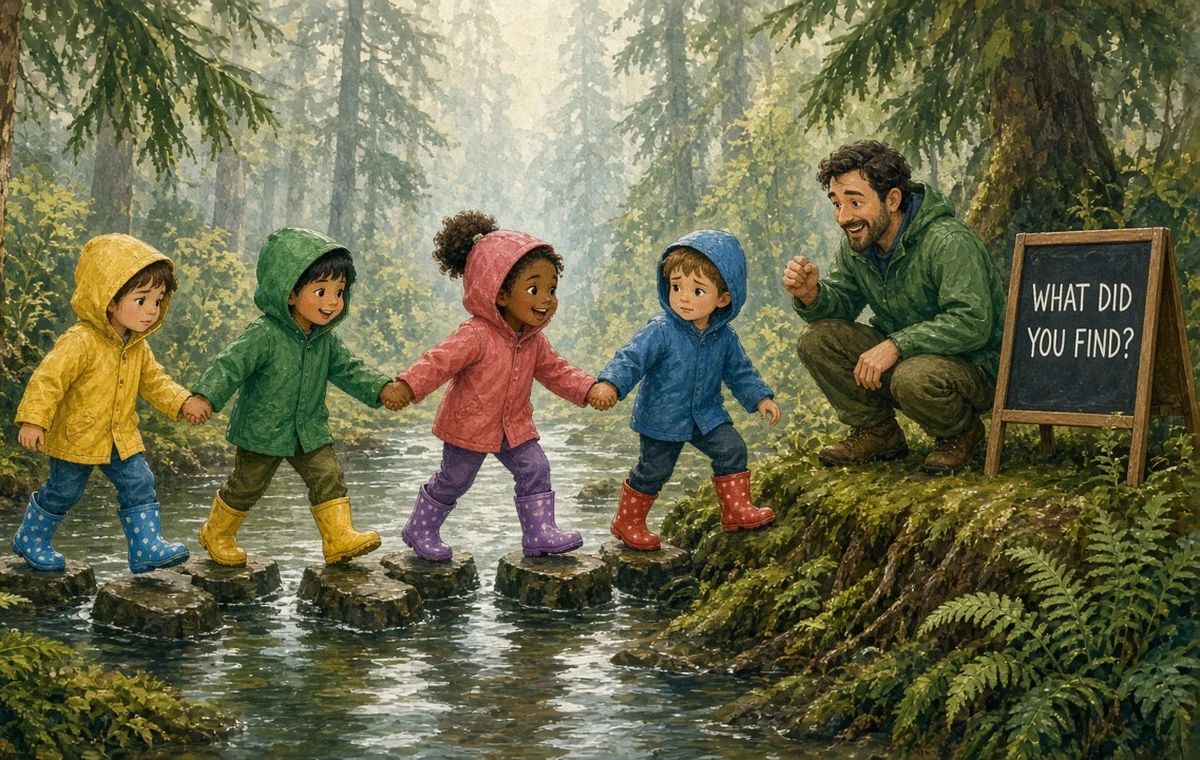
Teachers can turn any outing into language work with a few habits: ask open questions such as "What did you find?" instead of "Is that a leaf?", narrate what children are doing to give them new vocabulary, and invite them to retell the adventure back indoors through drawing or a class story. These small moves are where forest play becomes deliberate language teaching rather than just a nice walk.
What grows besides language?
The same study links forest activities with higher self-esteem, a better understanding of how others differ from us, stronger emotional regulation and a sense of living well alongside others. Climbing a slope or crossing a stream are just hard enough that children have to say what they want, ask for help or offer it, and then enjoy the shared relief when the group makes it.
Researchers in Norway have also found that natural playgrounds, with their uneven ground and trees, support motor development compared with flat playgrounds, which helps explain why physical confidence and verbal confidence often seem to rise together. Forest settings are not a cure-all, though, and the strongest evidence still comes from small studies, so the realistic claim is that they offer more opportunities for rich talk rather than guaranteed results.
How do the effects of forest activities compare at a glance?
Pulling the evidence together, it helps to separate what the environment provides from what children actually gain in speech and in character.
Student money tip on CampusDown Repair Up: Is a small leak worth a renters insurance claim? How to decide.
| Area | What the forest provides | Likely benefit |
|---|---|---|
| Environment | A setting that changes daily and seasonally; natural loose parts | Curiosity and new vocabulary |
| Interaction | Group play and shared problems | More peer conversation and negotiation |
| Language | Real experiences to describe and retell | Fluency, flexibility and originality |
| Emotion and character | Manageable risks and teamwork | Self-esteem, emotional regulation, cooperation |
The Korean source closes by arguing that language education should focus on communication and that forest experiences should be linked to concrete programs, such as making up a story about what happened in the woods, so that creativity in language grows alongside confidence. That also fits our wiki overview of play development theory, which shows how social and pretend play push children toward richer talk.
For families in the US and UK the practical takeaway is reassuring: you do not need a dedicated forest kindergarten to get many of the benefits. Regular time in the same local park, the freedom to get muddy and an adult who asks good questions will do much of the work.
Common mistakes
- Treating forest time as a break from learning rather than a language-rich learning setting.
- Asking only yes-or-no questions outdoors and missing chances for storytelling.
- Removing every challenge, so children have nothing to negotiate or describe.
- Assuming a one-off nature trip will have the same effect as regular sessions in the same place.
Quick self-check
- Can you explain fluency, flexibility and originality in children's language?
- Do you know how UK Forest School sessions differ from a full-day Waldkindergarten?
- Can you name two simple adult habits that turn outdoor play into language learning?
Compiled by the CampusDown editorial team from a Korean study summary on forest kindergartens and language development, Fjørtoft (2001) in Early Childhood Education Journal, the EYFS statutory framework, Forest School Association principles and public information on Washington State's outdoor preschool licensing. Reviewed November 2026. Educational overview, not individual child-development advice.
FAQ
What is a forest kindergarten?
An early-years setting where children spend most of the day outdoors in woods and nature, with only basic shelter for bad weather, an idea that began in Denmark and spread through Germany.
How is UK Forest School different?
Forest School usually runs as regular sessions, often weekly, in the same woodland, led by a trained leader, while a Waldkindergarten is outdoors almost all day, every day.
Why does forest play help language development?
Children play in groups, face real problems and touch real things, so they have more to describe, more to negotiate and more reasons to talk.
Which language skills improve most?
Studies summarized here link forest activities with gains in fluency, flexibility and originality of children's speech.
Do I need a forest kindergarten to get these benefits?
No. Regular time in the same local park or woods, permission to get muddy and open questions from adults can bring many of the same benefits.