
80 Years Since ENIAC: How Did Computers Change Our Lives? From Bletchley Park to AI, a History of Computing and Its Impact
- ENIAC, unveiled in Philadelphia in 1946, marks the public start of electronic digital computing, while Britain's Colossus had quietly run since 1944.
- Transistors, EDSAC, IBM System/360, the microprocessor and the PC carried computing from labs into homes, then smartphones and AI accelerators.
- Computing boosted productivity and assistive technology, but brought data breaches, algorithmic bias, a digital divide and growing e-waste.
Contents
A computer is a programmable machine that uses electronic circuits to carry out calculations and process data automatically, and the modern digital era is usually dated to ENIAC, unveiled at the University of Pennsylvania in February 1946. Eighty years later the descendants of that 30-ton machine sit in our pockets, steer our cars and write our emails. This guide follows the line from Philadelphia and Bletchley Park to smartphones and AI accelerators, then weighs what all that computing has given us and what it has cost.
What was ENIAC and why does 1946 matter?
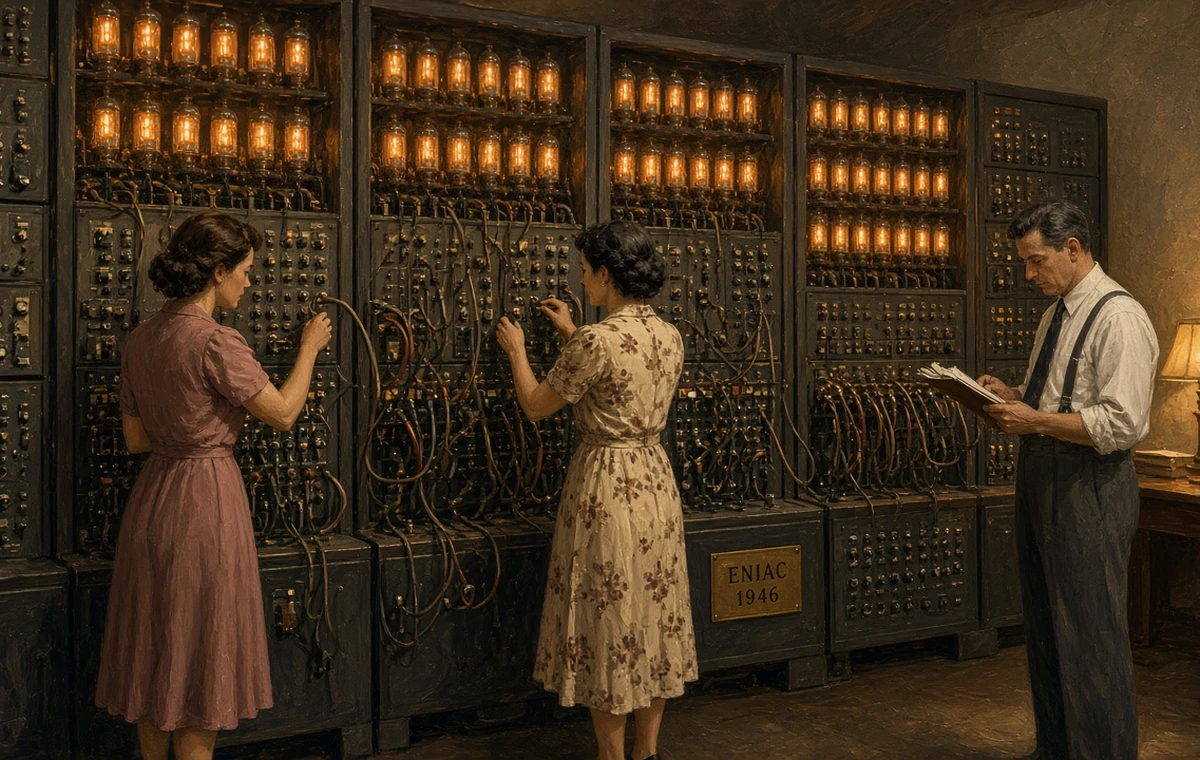
ENIAC, the Electronic Numerical Integrator and Computer, was built by John Mauchly and J. Presper Eckert for the US Army to calculate artillery firing tables. It used about 17,500 vacuum tubes, filled a room roughly 50 feet long and could perform around 5,000 additions a second, fast enough to work out a shell's trajectory in less time than the shell itself took to fly. Its first programmers, including Kathleen McNulty, Jean Jennings and Betty Snyder, were not even named at the 1946 press event; their story was recovered only decades later.
Student money tip from CampusDown Repair UpLandlord repair request letter template you can copy — what to include, how to send it, a follow-up version and how to keep a paper trail.
To feel how recent this is, compare it with other inventions that rebuilt daily life: Karl Benz's gasoline car in 1885, Martin Cooper's first handheld cellphone call in 1973. If human history were a single day, all of them would arrive in the last few seconds.

Who came before ENIAC in the US and UK?
ENIAC did not appear from nowhere. Blaise Pascal's geared adding machine of 1642 is usually called the ancestor of the computer. In the 1830s Charles Babbage designed the Analytical Engine with separate memory, processing, input and output, ideas far ahead of the brass gears available to build it, and Ada Lovelace wrote what is often called the first published program for it. In 1944 Harvard's electromechanical Mark I, built with IBM, ran long calculations automatically.
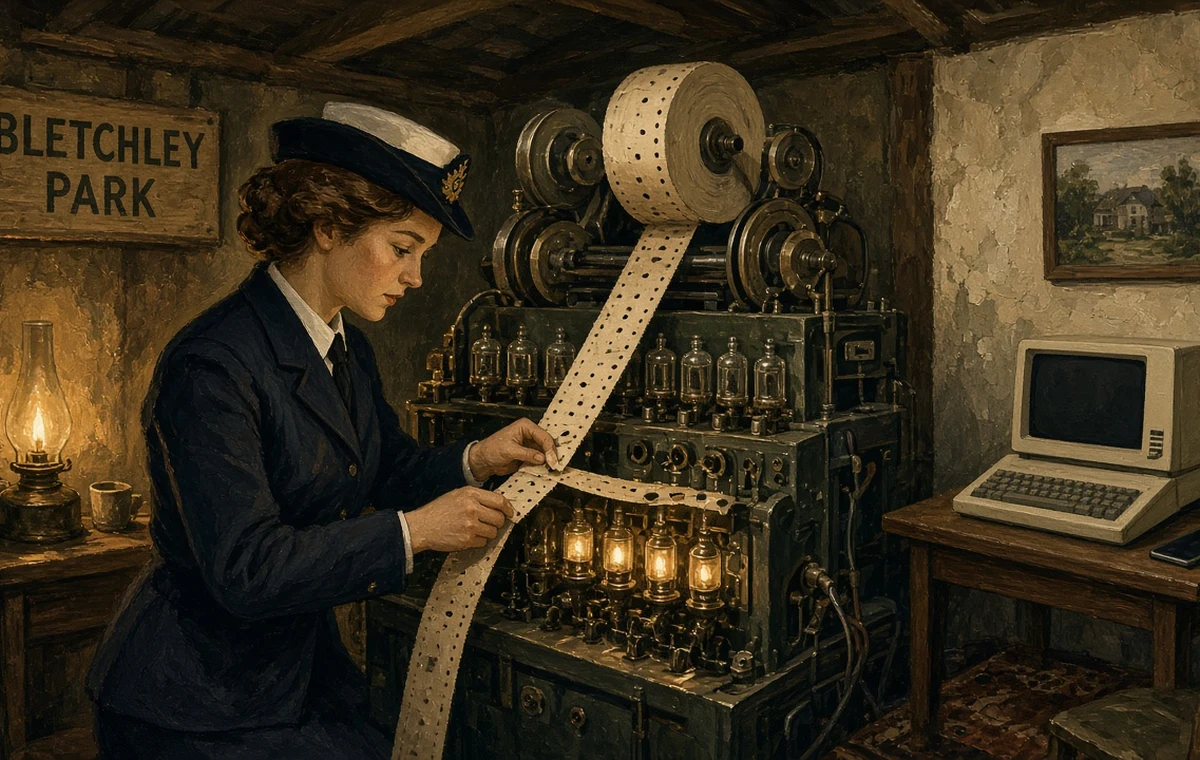
Across the Atlantic, Alan Turing's 1936 paper on computable numbers laid the theory of the general-purpose machine, and at Bletchley Park Tommy Flowers' Colossus, working from early 1944, became the first programmable electronic digital computer, used to break German Lorenz cipher traffic. Because Colossus stayed classified until the 1970s, ENIAC took the public credit. Turing's later question, whether a machine can think, still frames AI debates through the Turing test.
Skimming the section headings first makes a long guide much easier to map out. Try writing down one question of your own as you read.
How did computers develop from 1946 to today?
| Year | Machine or event | Why it mattered |
|---|---|---|
| 1946 | ENIAC, Philadelphia | Large-scale electronic digital computing goes public |
| 1947 to 1949 | Transistor at Bell Labs (Shockley, Bardeen, Brattain); EDSAC at Cambridge | Smaller, cooler switches; one of the first practical stored-program computers |
| 1951 | LEO I, J. Lyons and Co., London | The world's first business computer, running a tea-shop company's payroll and orders |
| 1964 | IBM System/360 | A compatible family of machines; software no longer died with each new model |
| 1971 | Intel 4004 microprocessor | A whole processor on one chip |
| 1977 to 1981 | Apple II, BBC Micro, IBM PC | Computers move into homes, schools and offices |
| 2007 | iPhone and the smartphone boom | A networked computer in every pocket |
| 2020s | GPU and AI accelerator clusters | Training large language models; computers that generate text and images |
Even before ENIAC, Herman Hollerith's punched-card tabulators had shown the payoff of automation: the 1880 US census took about eight years to process by hand, while his machines helped deliver the 1890 count in a fraction of that time. His company later became part of IBM.
How did computers change the way we live and work?
Faster processing did not simply give us more free time. Each speedup raised expectations, so the density of work and life increased: more emails, more meetings, more data to analyze. Automation shrank farm and factory labor, and more of our interactions moved from person-to-person to person-to-screen. Sociologists describe this shift with the idea of the information society, in which information itself becomes the main economic resource.
The productivity gains are real. Spreadsheets, CAD, online banking and video calls changed whole industries, and assistive technology changed individual lives: eye-tracking software lets people with ALS write and speak, and smart wheelchairs navigate on their own. Cyborg artist Neil Harbisson, born unable to see color, hears it through an antenna implanted in his skull.
What are the downsides of eighty years of computing?
- Privacy and security: the 2017 Equifax breach exposed data on about 147 million Americans, and the 2017 WannaCry ransomware attack disrupted NHS hospitals in England. Malware has evolved from the 1988 Morris worm into organized ransomware businesses.
- Algorithmic bias: systems trained on past data can repeat past discrimination, as a scrapped Amazon recruiting tool reportedly did with female applicants. Credit scoring and facial recognition face similar scrutiny.
- Digital divide: millions of rural and low-income households in the US and UK still lack reliable broadband or a usable device, which became painfully visible during school closures in 2020.
- E-waste: the world generated about 62 million tonnes of electronic waste in 2022 according to the UN Global E-waste Monitor, and only around a fifth was documented as properly recycled.
Student money tip on CampusDown Repair Up: Landlord repair request letter template you can copy.
The balanced view is not to reject computing but to use it with care: strong passwords and multi-factor login, regular updates, asking how an automated decision was made, and repairing or recycling old devices instead of binning them.
Reference: Ceruzzi, P. E. (2003). A History of Modern Computing (2nd ed.). MIT Press, a standard history of computing after ENIAC.
FAQ
When was ENIAC built?
ENIAC was unveiled at the University of Pennsylvania in February 1946 and is widely seen as the start of large-scale electronic digital computing.
Was Colossus earlier than ENIAC?
Yes. Colossus was working at Bletchley Park from early 1944, but it stayed secret until the 1970s, so ENIAC became better known.
What was the first business computer?
LEO I, built by the British catering firm J. Lyons and Co., ran its first business job in 1951.
What are the main positive effects of computers?
Productivity gains in work and study, wider entertainment, and assistive technology such as eye-tracking communication tools and smart wheelchairs.
What are the main negative effects of computers?
Data breaches and malware, algorithmic bias, the digital divide, and a growing volume of electronic waste.