
Does Raising the Minimum Wage Really Help Low-Paid Workers? Supply and Demand, Monopsony and Lessons From the US and UK
- A minimum wage is the legal floor on hourly pay, set in Korea by a tripartite commission.
- On the textbook graph a floor above equilibrium creates unemployment, but monopsony can reverse that.
- The US relies on states and cities, while the UK follows Low Pay Commission advice.
Contents
- What exactly is a minimum wage?
- Why can a higher wage create unemployment on paper?
- Why does the evidence not match the textbook?
- How does the United States handle its wage floor?
- How did Britain build its minimum wage?
- How do Korea, the US and the UK compare?
- Where do students get stuck when writing the essay?
- FAQ
Raise the minimum wage and the lowest-paid workers win. Or do they? Economists have been arguing about that question for nearly a century, and it still makes one of the liveliest debate assignments in any economics course. This guide walks through how Korea sets its wage floor, why a floor above the market wage can create unemployment on the textbook graph, why real-world evidence is messier, and how the United States and Britain have run their own very different experiments.
What exactly is a minimum wage?
A minimum wage is the lowest hourly pay an employer may legally offer. Its purpose is simple: to guarantee every worker a basic income floor, especially in low-paid service jobs where individual workers have little bargaining power. In Korea the idea first appeared in the 1953 Labour Standards Act, but a dedicated Minimum Wage Act only arrived in 1986. Today a tripartite Minimum Wage Commission of worker, employer and public-interest members debates the figure every summer, and the Minister of Employment and Labour announces the hourly rate for the following year.
Related on CampusDown Law UpDoes My Work-Study Job Have to Pay Minimum Wage? — a student's plain look at minimum wage, overtime, hours, and who to ask on campus first.
The source assignment, a four-page pro-and-con essay, argues that the floor matters more as personal service jobs multiply. A higher floor lifts the bottom of the pay ladder, narrows wage gaps and gives low earners a little more stability. A smart opening move is to pull the last few years of decided rates from the commission's website into a small table, so the debate that follows rests on real numbers rather than impressions.
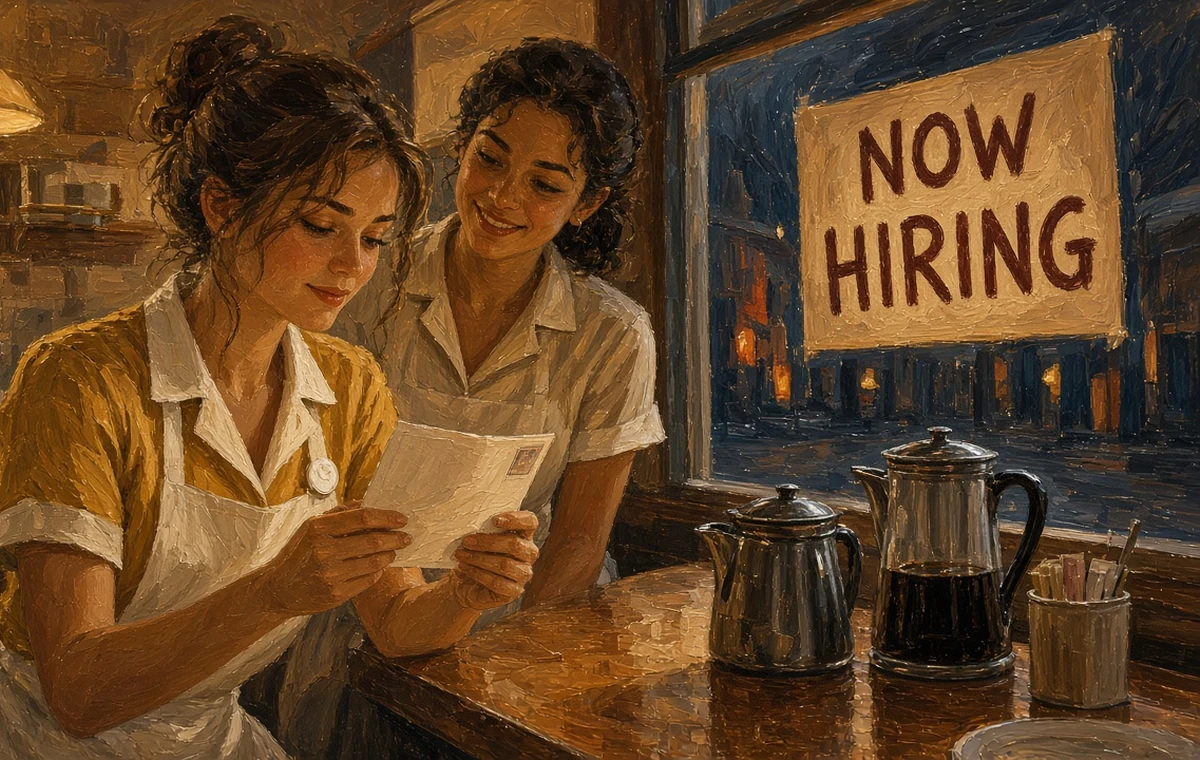
The picture above captures the optimistic half of the story. The sign in the window hints at the other half: if hiring gets more expensive, will that sign stay up for long, or will the owner quietly take it down?

Why can a higher wage create unemployment on paper?
Labour is priced in a market like anything else. Draw a demand curve for workers sloping down and a supply curve sloping up, and they cross at the equilibrium wage. Fix a legal minimum above that point and two things happen together: more people want jobs at the higher pay, while employers want fewer hours. The gap between the two quantities is the unemployment the textbook model predicts, and drawing that shaded gap on a single graph is the clearest way to show it in an essay.
The source warns that jobs where productivity is hard to raise are the most exposed. Think of small shops and family restaurants where margins are thin and machines cannot easily replace a person at the counter. Its policy conclusion is not to freeze wages but to pace increases so that businesses can adjust.
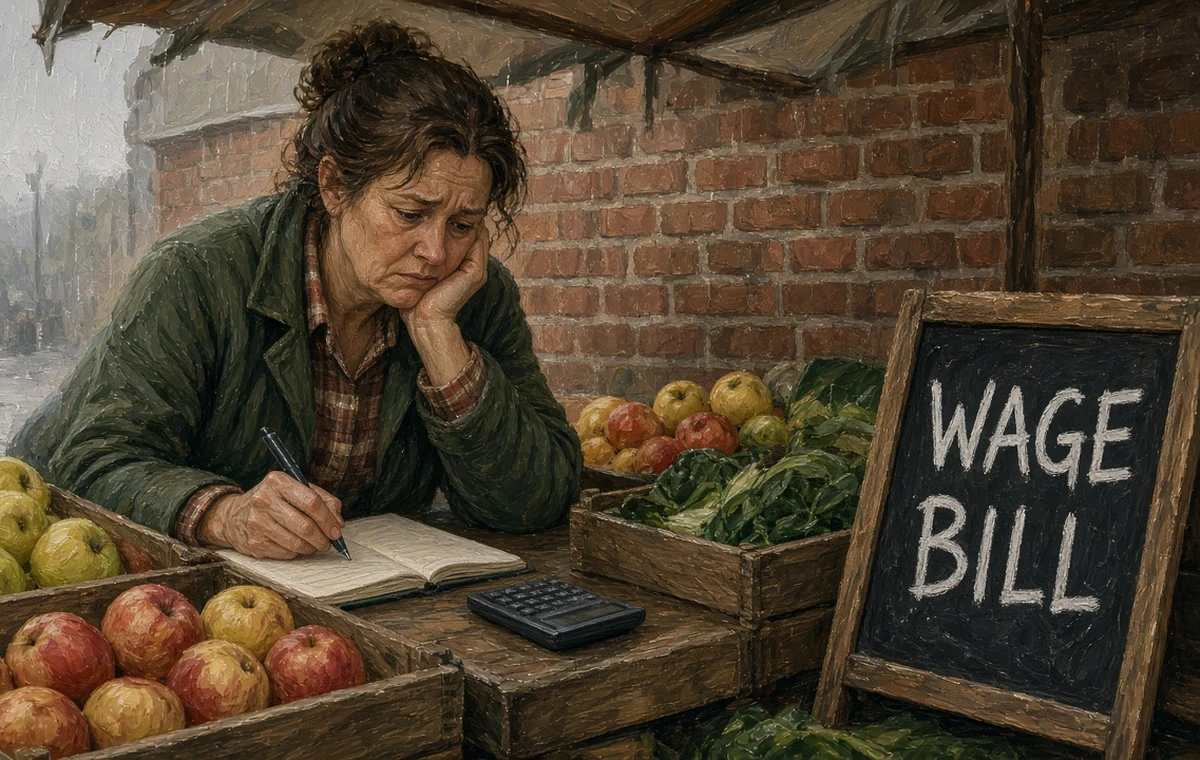
That anxious stallholder is the person the cautious side of the debate has in mind. A fair essay gives her a voice, then asks whether her worry is borne out by the evidence rather than assuming it.
Skimming the section headings first makes a long guide much easier to map out. Try writing down one question of your own as you read.
Why does the evidence not match the textbook?
Real labour markets are rarely perfectly competitive. When one large employer dominates a town, it can hold pay below what workers produce, and a modest legal floor can then raise both wages and employment. Economists call this situation monopsony, and it is the single most useful idea for the opposing side of any minimum wage debate.
The empirical turning point came in 1994, when David Card and Alan Krueger compared fast-food restaurants in New Jersey, which had just raised its minimum, with neighbouring Pennsylvania, which had not. They found no clear loss of jobs, a result that set off decades of replication and rebuttal. Card later shared the 2021 Nobel memorial prize partly for this kind of natural experiment. Studies since then point in different directions depending on the size of the rise, the region and the workers studied, so a good essay presents the range rather than declaring a winner. Our explainer on the economics of the minimum wage summarises the main schools of thought.
How does the United States handle its wage floor?
A federal floor that stopped moving
The federal minimum dates back to the Fair Labor Standards Act of 1938. It has been $7.25 an hour since July 2009, the longest stretch without a rise since the law began. Tipped workers can legally be paid a much lower cash wage as long as tips bring them up to the federal minimum, a rule critics say leaves restaurant staff exposed.
States and cities fill the gap
Because Congress has not acted, the real action has moved to states and cities. Many now set their own floors well above the federal rate, and several index them to inflation so they rise automatically. The "Fight for $15" campaign, launched by fast-food workers in 2012, turned a once radical number into law in a number of places. The result is a patchwork in which a cashier's legal minimum can differ sharply just by crossing a state line, which also gives researchers a steady supply of border comparisons like the original Card and Krueger study.
When the Congressional Budget Office has modelled a much higher federal floor, it has projected both higher pay for millions of workers and some job losses, with wide uncertainty around the size of each. That mixed forecast is a gift for a balanced essay.
How did Britain build its minimum wage?
The National Minimum Wage and the Low Pay Commission
The UK had no general statutory minimum until the National Minimum Wage Act 1998, which came into force in April 1999 amid warnings of mass job losses that largely failed to appear. An independent Low Pay Commission, with members drawn from employers, unions and academia, studies the evidence each year and recommends rates; ministers almost always accept them. This advisory model is a useful contrast with Korea's negotiating commission, where worker and employer members often walk out.
The National Living Wage
In April 2016 the government added a higher "National Living Wage" for older workers and set a target linking it to two-thirds of median earnings. The age threshold has since come down step by step, from 25 to 23 and then to 21. Separately, the voluntary Real Living Wage, calculated by the Living Wage Foundation from the cost of living, is paid by thousands of accredited employers. HM Revenue and Customs enforces the legal rates and the government periodically publishes the names of employers found underpaying, a reputational penalty many firms fear more than the fine.
Britain's experience gives the essay a neat lesson: a rate set by an evidence-led body, and raised predictably, made large increases politically easier, though debate about effects on young and part-time workers never fully disappeared.
How do Korea, the US and the UK compare?
| Issue | Korea | United States | United Kingdom |
|---|---|---|---|
| Legal basis | Minimum Wage Act 1986 | Fair Labor Standards Act 1938 | National Minimum Wage Act 1998 |
| Who sets the rate | Tripartite Minimum Wage Commission, announced by the labour minister | Congress for the federal floor; states and cities can go higher | Government, on Low Pay Commission advice |
| Coverage | One national hourly rate | Federal floor plus many higher local rates | Age-banded rates, highest for those 21 and over |
| Enforcement highlight | Labour inspections and penalties | Department of Labor wage-and-hour cases | HMRC checks and public naming of underpayers |
The comparison shows that the economics may be universal, but the politics of who decides, and how quickly, varies enormously. That institutional detail is exactly what lifts a debate essay above a recited graph.
Where do students get stuck when writing the essay?
The most common trap is treating the textbook graph as a description of what actually happened. Other frequent slips are quoting rates without checking the year, collecting evidence for only one side and ending with an opinion that floats free of the arguments above it.
Also on CampusDown Law Up: Does My Work-Study Job Have to Pay Minimum Wage?
Imagine preparing for a seminar debate. You could pull the latest decided rate and the official statements of both the employer and union sides, summarise each in three lines, then draw two versions of the supply and demand graph, one competitive and one with a dominant employer, and show how the same rise produces different results.
- Have you checked the rate for each year you cite?
- Have you shaded the unemployment gap on the graph?
- Have you given arguments for and against?
- Have you separated theory from empirical findings?
- Have you stated your own view with reasons?
Finish by proposing one complementary policy, such as an in-work tax credit or support for small employers, so your conclusion offers a way forward rather than just a verdict.
Who will find this useful?
This approach suits anyone writing a minimum wage essay for introductory economics, labour economics or social policy, and anyone preparing for a formal debate. The structure of purpose, need, fit and employment effects travels well to other policy questions too. Rates change every year, so always swap in the latest official figures before you submit.
FAQ
What is the federal minimum wage in the United States?
It has been $7.25 an hour since July 2009, though many states and cities set higher rates.
Who recommends the UK minimum wage?
The independent Low Pay Commission, whose recommendations the government almost always accepts.
Why might a minimum wage cause unemployment?
If the floor sits above the market wage, more people seek work while employers demand fewer hours, leaving a gap.
What did Card and Krueger find?
Comparing New Jersey and Pennsylvania fast-food jobs in the early 1990s, they found no clear job losses after a rise.
How should I end a minimum wage debate essay?
State your view with evidence and propose a complementary policy, such as in-work tax credits or help for small firms.