
Does Equal Schooling for All Solve the Problem? Compulsory Education Pros and Cons, from Korea to US Attendance Laws and England's Learning-to-18 Rule
- Compulsory education guarantees every child a basic education so learning does not depend on family wealth.
- Korea, the US and England reached it by different routes, from constitutional rights to state laws and parents' duties.
- It widened opportunity, but tutoring gaps, absenteeism and policy churn remain the big unsolved problems.
Contents
Compulsory education is the rule that every child must receive a basic education, paid for and guaranteed by the state, so that the right to learn does not depend on a family's wealth or luck. Yet the school gates have been open to everyone for generations and people still argue about education gaps. This guide follows the Korean case material, then holds it up against the American and British experience: who made schooling compulsory, what it fixed, and which problems it quietly created.
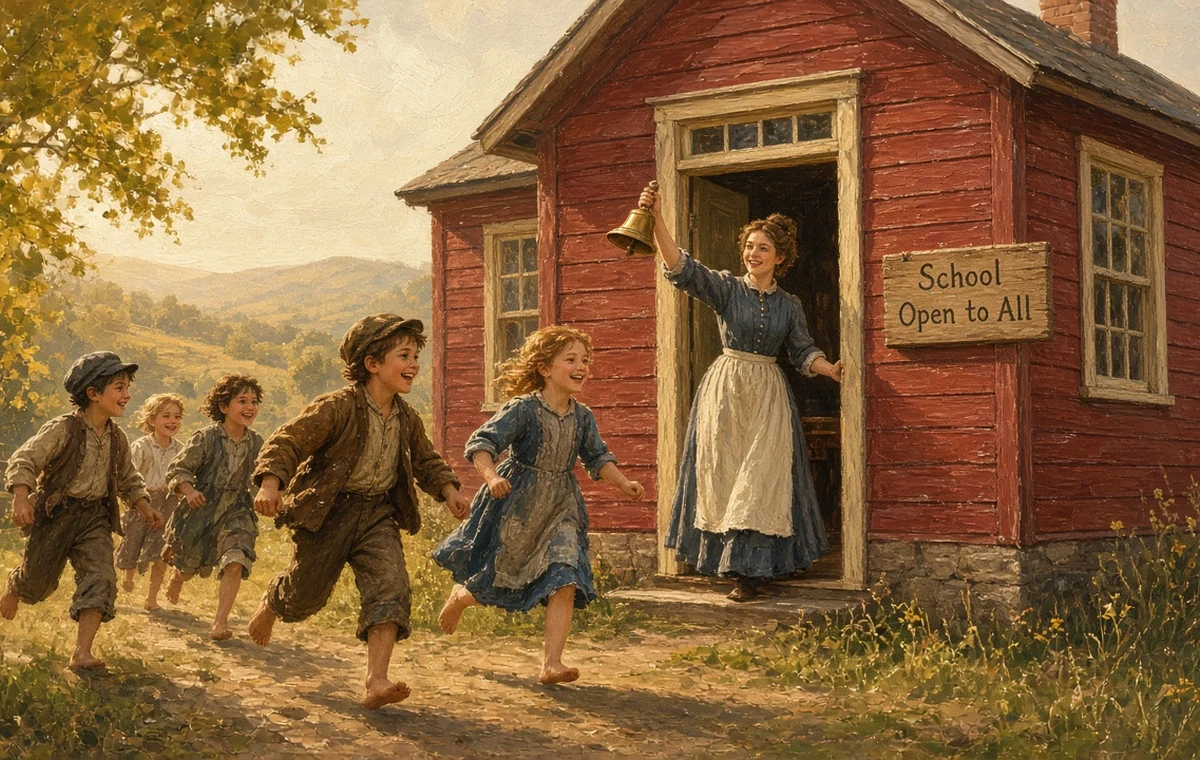
For most of history, learning to read was a perk of the powerful. Schools trained clergy, officials and the sons of the wealthy, and education helped keep social rank in place. That changed slowly, and the change is worth retelling because it explains why governments now feel responsible for every child's first decade of schooling.
Why did education become a right?
The source material traces the shift to the civic revolutions of the 18th and 19th centuries. Once ordinary people claimed political rights, it followed that they needed the literacy to use them, and democratic constitutions began listing education as a basic right. The idea of learning across a whole lifetime, explored in lifelong education, grew out of the same belief.
Student money tip from CampusDown Law UpMy Landlord Is Raising Rent at Renewal. How Much Notice Do I Get? — Landlord raising rent at lease renewal?
The United States and Britain both lived that story. In Massachusetts, reformer Horace Mann championed tax-funded "common schools," and in 1852 the state passed the first general compulsory attendance law in the country. Other states followed over the next six decades; Mississippi, in 1918, was the last. In England, the Elementary Education Act of 1870, often called Forster's Act, set up school boards to fill gaps in provision, attendance became compulsory nationally in 1880, and elementary fees were largely abolished in 1891.
The logic in all three countries was similar: if a person is to discover their potential and take part in public life, the state has to guarantee a fair starting point, and that guarantee became the foundation of compulsory schooling.

What exactly counts as compulsory education?
In the Korean case, compulsory education means the state provides basic schooling to every citizen. Article 31 of the Korean Constitution says everyone has an equal right to education according to their ability, and that parents must ensure their children receive at least elementary education plus whatever further schooling the law requires.
The American version is more scattered. The US Constitution never mentions education, and in San Antonio v. Rodriguez (1973) the Supreme Court declined to treat it as a fundamental federal right. Instead, every state constitution promises a public school system, and state law sets the attendance ages. One federal ruling matters a lot, though: in Plyler v. Doe (1982) the Court held that states cannot shut undocumented children out of free public schools.
In England the duty sits with parents. Section 7 of the Education Act 1996 says parents must make sure a child of compulsory school age receives efficient, full-time education suited to their age, ability and any special needs, "either by regular attendance at school or otherwise." Those last two words are why home education is legal in England, a point we return to below.
Skimming the section headings first makes a long guide much easier to map out. Try writing down one question of your own as you read.
What are the advantages of compulsory schooling?
The case material lists three main benefits, and they apply on both sides of the Atlantic.
- Equal opportunity: every child gets the same baseline, regardless of family income.
- A chance to grow: talent is discovered in children whose parents could never have paid for school.
- A wider road to higher education: once nearly everyone finishes basic schooling, college and university become realistic for far more people.
Because it puts everyone on the same starting line, compulsory schooling is usually judged as good for both individual growth and social cohesion. Keeping that benefit, however, means watching the gaps that open up outside the system.
Which problems are still unsolved?
The Korean source is frank about the downsides. It points to school violence, bullying and pupils who struggle to adjust to school life, and to education policy that changes so often that families and teachers lose their bearings. Above all, when families lean too heavily on private tutoring, the equal opportunity that compulsory schooling was meant to protect starts to erode, and that inequality spills back into society.

American and British readers will recognise each item. In the US, chronic absenteeism, usually defined as missing at least 10 percent of the school year, rose sharply after the pandemic and has become a national worry. In England, government figures on persistent absence followed a similar path, and private tuition remains common among better-off families, which is exactly the "uneven starting line" the Korean material describes.
So the question is not whether compulsory schooling works, but whether policy keeps pace with the pressures that grow around it, from tutoring markets to pupils who simply stop turning up.
How did Korea widen compulsory schooling over time?
Korea did not build its system overnight. The 1948 Constitution declared that at least elementary education should be compulsory and free, and the Education Act of 1949 put that into law. War left schools and budgets in ruins, so it was only in the mid to late 1950s that elementary enrolment reached almost every child, often in crowded classrooms running morning and afternoon shifts.
Middle school came next. Entrance exams were phased out from 1969, compulsory middle schooling started around 1985 in remote and island areas, and between 2002 and 2004 it covered every grade nationwide. High school is still not compulsory, but tuition-free high school began with final-year students in 2019 and reached all grades in 2021. Since 2012 the Nuri curriculum has subsidised early education for five-year-olds, later extended to three- and four-year-olds. A 2015 law created support centres for young people who leave school, and homeschooling is not officially recognised, so many home-educated Koreans gain qualifications through national equivalency exams.
Set against the American and British timelines, the most striking difference is how the three countries draw the age lines and what they accept as "education."
How do the US and the UK draw the lines?
In the United States the start and end ages differ by state. Most states require attendance from around age 5 or 6 until somewhere between 16 and 18, and several have raised the leaving age in recent years. In England, the Education Act 1944 raised the school leaving age to 15 from 1947, and it rose to 16 in 1972. The Education and Skills Act 2008 then introduced the "raising of the participation age": since 2013 young people have had to stay in education or training until 17, and since 2015 until their 18th birthday. Crucially, that can mean college, an apprenticeship, or work combined with part-time study, not necessarily a school desk.
| Item | Korea | United States | England |
|---|---|---|---|
| Legal basis | Constitution Article 31 and education laws | State constitutions and state attendance laws | Education Act 1996 (parents' duty) |
| Compulsory span | Elementary and middle school (9 years) | Usually about age 5–6 to 16–18, set by each state | School age 5 to 16, then education or training until 18 |
| High school | Not compulsory, tuition-free since 2021 | Free public high school; compulsory up to the state's leaving age | Sixth form, college or apprenticeship until 18 |
| Home education | Not recognised; equivalency exams used | Legal in all 50 states, rules vary | Legal; new local registers being introduced |

Is homeschooling allowed?
Homeschooling is legal in every US state, though the paperwork ranges from almost nothing to regular testing and portfolio reviews. England is shifting. The Children's Wellbeing and Schools Act 2026, which received Royal Assent on 29 April 2026, requires local authorities to keep registers of children not in school, and the government has said the mandatory registers will be in place across England by the end of the current Parliament. Supporters see a safeguarding net; critics worry about state intrusion into family choices. Korea's debate runs along the same fault line between parental choice and child protection, and some education thinkers go further still, as the deschooling theory of Ivan Illich and Everett Reimer shows.
Whichever country you look at, home education forces a clear question: is the state guaranteeing schools, or guaranteeing learning? The answer shapes how far governments reach into family life.
How did school expansion change everyday life?
The source sums up the trade-offs in a simple table, and the pattern is surprisingly universal.
Student money tip on CampusDown Law Up: My Landlord Is Raising Rent at Renewal. How Much Notice Do I Get?.
| Aspect | Effect |
|---|---|
| Easier | Far wider access to higher education |
| Harder | Heavier spending on private tutoring |
| Policy | Confusion from frequent reforms |
| Inside schools | Violence, bullying and difficulty adjusting to school |
Classrooms that were once packed shoulder to shoulder are emptying as birth rates fall, in Korea most dramatically but also in parts of the US and UK. Shrinking cohorts will test compulsory systems in new ways, from school closures to teacher supply. The core lesson stays the same: opening the door was the first step, and keeping the starting line fair needs consistent policy and less dependence on paid tutoring.
Reference: Tyack, D. B. (1974). The one best system: A history of American urban education. Harvard University Press, a classic account of how US public schooling was built.
FAQ
What is compulsory education?
It is a legal requirement that children receive a basic education, provided free by the state, so that every child has an equal starting point.
What age is school compulsory in the US?
It depends on the state, but most require attendance from about age 5 or 6 until somewhere between 16 and 18.
Do you have to stay in school until 18 in England?
Since 2015 young people in England must stay in education or training until 18, which can include college, an apprenticeship or part-time study alongside work.
Is homeschooling legal in the US and UK?
Yes. It is legal in all 50 US states with varying rules, and legal in England, where new local registers of children not in school are being introduced.
What are the main criticisms of compulsory schooling?
Critics point to bullying, pupils who struggle to fit in, frequent policy changes and private tutoring that recreates inequality outside the classroom.