
The 12 Chinese Zodiac Animals in Order, and Why January and February Birthdays Depend on Lunar New Year vs Lichun
- The order is Rat, Ox, Tiger, Rabbit, Dragon, Snake, Horse, Goat, Monkey, Rooster, Dog and Pig, each tied to an Earthly Branch.
- Animals repeat every 12 years, while the full stem-and-branch label, such as the 2026 Fire Horse, repeats every 60.
- January and February birthdays can change animals depending on whether you count from Lunar New Year or from Lichun around February 4.
Contents
- What is the order of the 12 zodiac animals?
- Why does the same animal come back every 12 years, and the same "full sign" every 60?
- Born in January or February? Lunar New Year vs Lichun explained
- Celebrity and history trivia: the classic January birth-year pitfall
- How does this compare with Western Greco-Roman astrology?
- FAQ
The twelve zodiac animals run in a fixed order: Rat, Ox, Tiger, Rabbit, Dragon, Snake, Horse, Goat, Monkey, Rooster, Dog and Pig. Each animal is a nickname for one of the twelve "Earthly Branches" used to count years in China, Korea, Japan and Vietnam. The tricky part is not the order but the start line: if you were born in January or early February, your animal depends on whether the year turns at Lunar New Year or at Lichun, the solar "Start of Spring" around February 4.
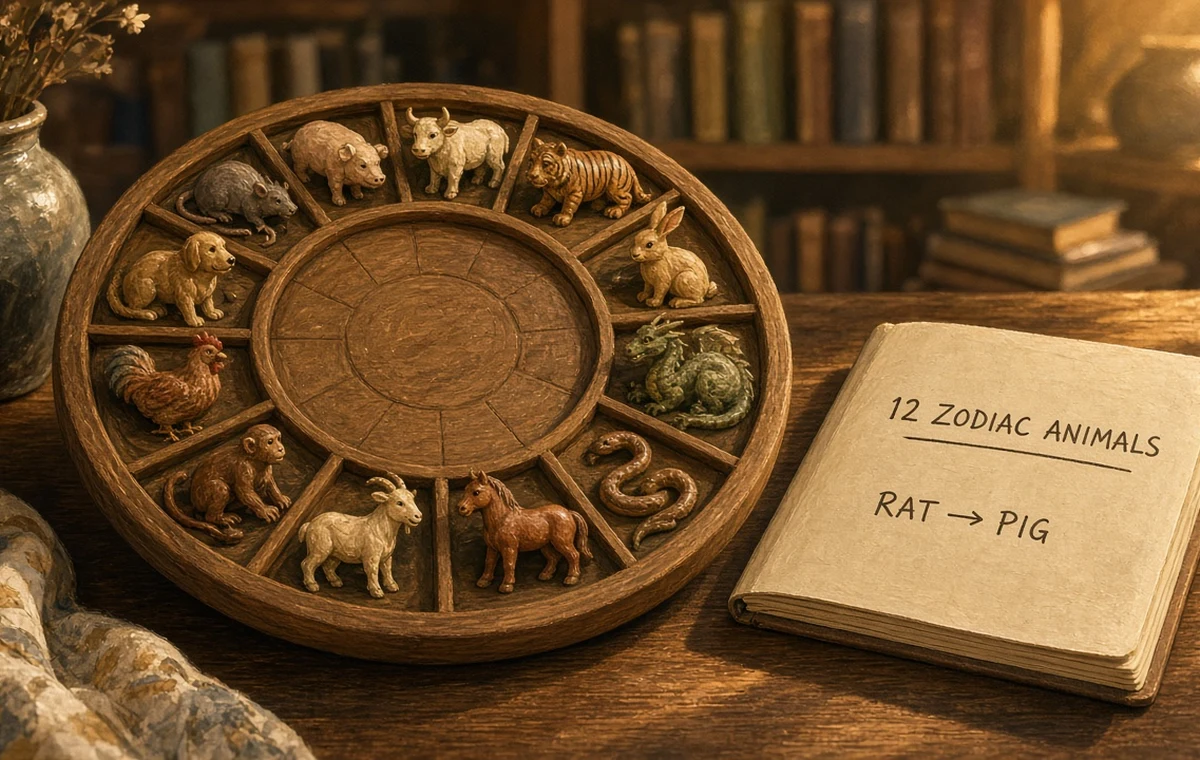
This guide gives you the full sequence, the 12-year and 60-year cycles, the January/February boundary problem with real calendar dates, and a quick comparison with the Western sun signs most English speakers grew up reading in the back of a magazine.
What is the order of the 12 zodiac animals?
The animals are attached to the Earthly Branches, a set of twelve Chinese characters that also once labelled the hours of the day and the points of the compass. The branch comes first; the animal is the friendly mascot stuck on top. That is why scholars say the "Rat year" is really the "Zi year".
Student money tip from CampusDown Life UpHow to search official databases for unclaimed money in your name — free state and federal searches, and how to avoid paid finders and scams.
| Order | Branch | Pinyin | Animal | Recent years (approx.) |
|---|---|---|---|---|
| 1 | 子 | zi | Rat | 2008, 2020 |
| 2 | 丑 | chou | Ox | 2009, 2021 |
| 3 | 寅 | yin | Tiger | 2010, 2022 |
| 4 | 卯 | mao | Rabbit | 2011, 2023 |
| 5 | 辰 | chen | Dragon | 2012, 2024 |
| 6 | 巳 | si | Snake | 2013, 2025 |
| 7 | 午 | wu | Horse | 2014, 2026 |
| 8 | 未 | wei | Goat (or Sheep) | 2015, 2027 |
| 9 | 申 | shen | Monkey | 2016, 2028 |
| 10 | 酉 | you | Rooster | 2017, 2029 |
| 11 | 戌 | xu | Dog | 2018, 2030 |
| 12 | 亥 | hai | Pig | 2019, 2031 |
A quick memory trick for English speakers: say the list in three beats of four, "Rat-Ox-Tiger-Rabbit / Dragon-Snake-Horse-Goat / Monkey-Rooster-Dog-Pig". The "recent years" column is only a rough guide, because each of those years really starts somewhere between late January and mid-February, which is exactly where people trip up.
Not every culture uses the same cast. In Vietnam the fourth animal is the Cat rather than the Rabbit, and the Ox is usually a water buffalo. Japan keeps the Rabbit but turns the twelfth animal into a wild boar. If a friend insists they are a "Cat year", they may simply be counting the Vietnamese way.

Why does the same animal come back every 12 years, and the same "full sign" every 60?
After the Pig comes the Rat again, so two people born exactly 12, 24 or 36 years apart usually share an animal. But Chinese years are also tagged with ten "Heavenly Stems", often linked to the five elements (wood, fire, earth, metal, water) in a yin and yang pair. Ten stems and twelve branches line up again only every 60 years. That is why 2026 is not just a Horse year but a Fire Horse year (bingwu), a combination last seen in 1966.
Fire Horse years carry folklore baggage in East Asia. In Japan, a superstition that girls born in a Fire Horse year would be headstrong was blamed for a sharp dip in births in 1966. Whether or not you care about the folklore, it shows that the 60-year label can matter to real families more than the animal alone.
Skimming the section headings first makes a long guide much easier to map out. Try writing down one question of your own as you read.
Born in January or February? Lunar New Year vs Lichun explained
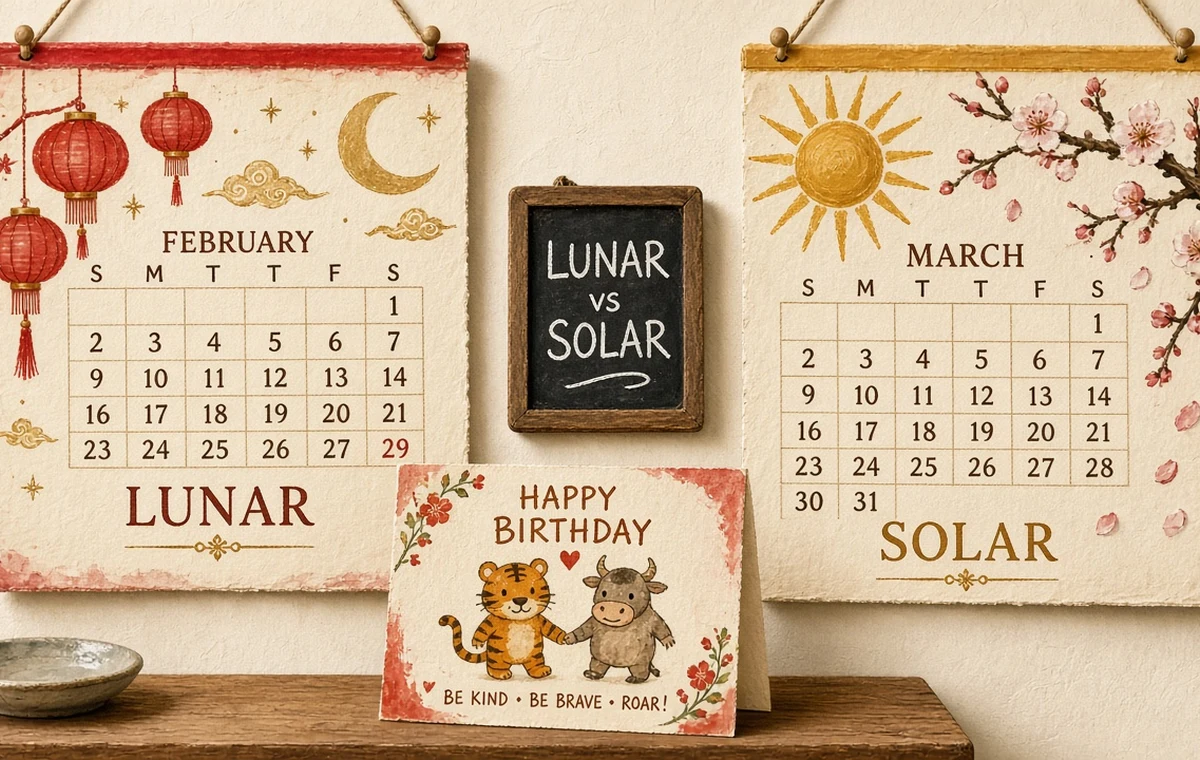
Here is the core problem. The Gregorian year starts on January 1, but neither traditional boundary does. Two candidates exist, and they rarely fall on the same day:
- Lunar New Year (Spring Festival): the first day of the first lunar month, which wanders between about January 21 and February 20. Most families, restaurants and greeting cards switch animals here.
- Lichun (Start of Spring): one of the 24 solar terms, fixed by the sun's position and landing around February 3 to 5 every year. Traditional Four Pillars (BaZi) astrology switches the year here, sometimes down to the minute.
| Year | Lichun (solar) | Lunar New Year | Born in the gap | By Lichun | By Lunar New Year |
|---|---|---|---|---|---|
| 2024 | Feb 4 | Feb 10 | Feb 4 to 9 | Dragon | Rabbit |
| 2025 | Feb 3 | Jan 29 | Jan 29 to Feb 2 | Dragon | Snake |
| 2026 | Feb 4 | Feb 17 | Feb 4 to 16 | Horse | Snake |
Notice that the gap can run in either direction. In 2025 Lunar New Year came early, so a baby born on January 31 was a Snake at the family dinner table but still a Dragon in a BaZi chart. In 2026 it came late, so a February 10 baby is a Horse by the solar rule and a Snake by the festival rule. Neither answer is a calculation error. They are two different traditions answering the same question.
- Check which calendar the birth date is written in. Older relatives sometimes remember lunar dates, not Gregorian ones.
- Decide what the answer is for. A party theme or a fun quiz can follow Lunar New Year; a BaZi or feng shui reading will expect Lichun.
- Look up that exact year. Both boundaries move, so never assume "February 4" or "the first new moon" without checking.
- Say which rule you used. "Snake by Lunar New Year, Dragon by Lichun" is more accurate than picking one and arguing.
In short, a January or February birthday has two honest answers, and naming the rule is what turns a family argument into a clear explanation.
Celebrity and history trivia: the classic January birth-year pitfall
Pop-culture lists of "famous Dragons" or "famous Tigers" are a fun read, but many are built by matching Gregorian birth years to animals. Anyone born in January, and often early February, can end up in the wrong column. Before you share a viral list, check the Lunar New Year date for that person's birth year. The same applies to historical figures: dates recorded before a country switched to the Gregorian calendar may need converting first.
Quiz writers and history students should treat the zodiac like any other dating system. Write down the source calendar, the boundary rule and the result, and you will avoid the most common "Actually, she's a Rabbit" corrections in the comments.
How does this compare with Western Greco-Roman astrology?
English-speaking readers usually meet astrology through monthly sun signs, from Aries to Pisces. The two systems both use twelve symbols, but they slice time very differently.
Student money tip on CampusDown Life Up: How to search official databases for unclaimed money in your name.
| Feature | Chinese zodiac | Western sun signs |
|---|---|---|
| What changes every twelve units | Years (12-year cycle) | Roughly months (12 signs a year) |
| Starting point | Lunar New Year or Lichun | Aries, around the March equinox |
| Basis | Earthly Branches plus Heavenly Stems | Constellations along the ecliptic, from Babylonian and Greek tradition |
| Who shares your sign | Everyone born in the same zodiac year | Everyone born in the same 30-day window |
| Common modern use | Festivals, greetings, family conversation | Horoscope columns, personality memes |
So a person can be a Snake and a Capricorn at the same time without contradiction: one label comes from the year, the other from the month. What neither system offers is scientific evidence that the label predicts personality. Korea's National Folk Museum, which documents zodiac customs, likewise notes that the link between birth animal and character has not been scientifically proven. Enjoy the stories; do not use them to judge a job applicant or a date.
Common mistakes to avoid
- Assuming every January baby belongs to the previous animal.
- Treating Lichun and Lunar New Year as the same day.
- Reading zodiac personality traits as if they were test results.
Quick self-check
- Do the branch characters and animals match the table?
- Did you note whether the birth date is Gregorian or lunar?
- Did you name the boundary rule you used?
- Did you keep folklore separate from facts about a real person?
Compiled by the CampusDown editorial team from public material on the Earthly Branches, solar terms and Lunar New Year dates. Reviewed November 2026. Cultural information only; it does not predict personality or fortune.
FAQ
I was born on February 10, 2026. Am I a Horse or a Snake?
By Lichun (February 4, 2026) you are a Horse. By Lunar New Year (February 17, 2026) you are a Snake. Both are legitimate traditions, so say which rule you are using.
Why does my Vietnamese friend say she is a Cat?
In the Vietnamese zodiac the Cat takes the fourth place that the Rabbit holds in the Chinese version. The order and years are otherwise the same.
Is it Goat or Sheep?
The character 未 covers both animals in Chinese, so English sources use Goat, Sheep or Ram. They all refer to the eighth position.
Can I be a Dragon and a Leo at the same time?
Yes. The Chinese animal comes from your birth year and the Western sun sign from your birth date within the year, so the two labels are independent.
Does my zodiac animal decide my personality?
No scientific study supports that. Treat the animal traits as cultural storytelling rather than a personality test.