
Cartel vs Trust vs Konzern: How Firms Combine, Why Price-Fixing Is Illegal, and How the Sherman Act and UK Competition Law Fight Back
- A cartel ties independent firms together by agreement, while a trust merges them into a single company.
- A konzern keeps companies legally separate but controls them through a holding company's shares.
- The US Sherman Act, UK Competition Act and Korea's Fair Trade Act all ban price-fixing and reward the first to confess.
Contents
Cartels, trusts and konzerns (holding-company groups) are the three classic ways firms combine: a cartel ties independent companies together by agreement, a trust merges them into one, and a konzern controls them through share ownership. Whenever a news story says flour mills, egg producers or chipmakers "raised prices together" and got fined, the word cartel is never far away. This guide unpacks the three forms the way business textbooks do, then shows how American and British competition law deals with each of them.
The three forms differ in one thing above all: the strength of the rope that ties the companies together. A handshake deal, a single merged company and a parent that owns the shares are very different animals, and the law treats them differently too.
Why do companies combine in the first place?
The Korean source material gives three motives. The first is to soften competition so prices and profits become more predictable. The second is to link stages from raw materials to retail so that transaction costs fall. The third is to pool capital so a group can afford investments no single firm could carry alone.
Markets with only a handful of sellers are where these motives bite hardest, which is why the theory of oligopoly is the natural companion to this topic. With few rivals, each firm watches the others closely, and the temptation to coordinate rather than compete grows.
The key point for any essay is that not all combinations are bad. A merger that genuinely lowers costs can benefit shoppers, while an agreement that only blocks competition simply moves money from customers to sellers. Separating those two motives is the starting point for every fair assessment.

How does a cartel hold together?
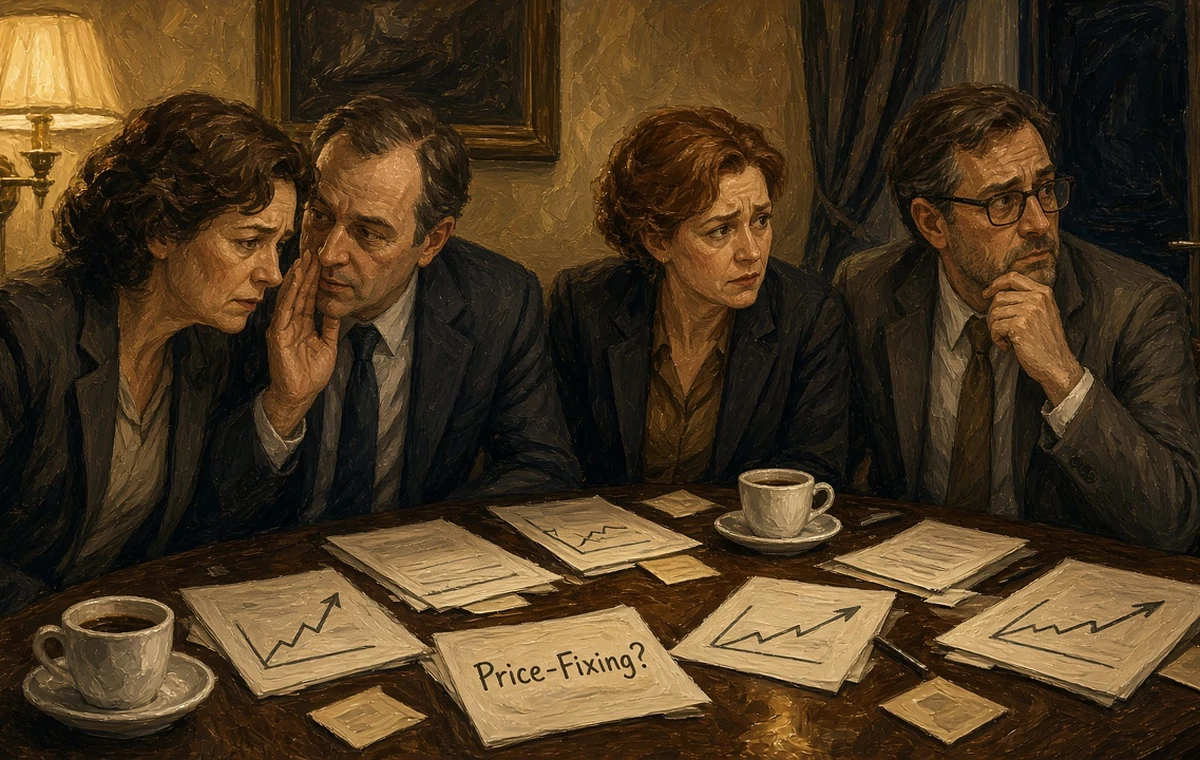
A cartel is a group of firms in the same industry that remain legally and financially independent but agree on prices, output, sales territories or bids. Because the only tie is an agreement, economists call it the loosest form of combination.
That looseness is also its weakness. In his 1964 paper "A Theory of Oligopoly," George Stigler argued that every cartel member is tempted to undercut the agreed price in secret to win extra sales, so policing the deal is costly and fragile. It is the business version of the prisoner's dilemma: everyone gains if all cooperate, but each gains most by cheating.
Real cartels that made headlines
American readers may remember the lysine price-fixing case of the 1990s, in which an executive turned FBI informant secretly recorded meetings between rival producers, a story later dramatised in the film The Informant!. In Britain, the Office of Fair Trading fined retailers, football clubs and a kit maker in 2003 for fixing the prices of replica football shirts, a case that showed cartels are not just about heavy industry but about the things families buy every week.
Both cases fit Stigler's logic neatly: the agreements needed constant meetings and checks, and they collapsed once one insider decided cooperation with the authorities paid better than loyalty to the group.
Skimming the section headings first makes a long guide much easier to map out. Try writing down one question of your own as you read.
What separates a trust from a konzern?
A trust is the tightest form. The member companies give up their independence and become, in effect, one enterprise. The name comes from the late 19th-century American oil industry, where shareholders of many companies handed their stock to a board of trustees who ran everything as a single business. In modern language, a trust is close to a full merger.

The best-known example is the Standard Oil Trust, formed in 1882. In 1911 the US Supreme Court upheld an order to break the company into dozens of separate firms, a landmark that still shapes how Americans think about corporate size.
A konzern, a term borrowed from German, sits between the two. Each company stays legally separate, but a holding company owns enough shares to control management. Unlike most cartels, which join firms in the same industry, a konzern can bundle a bank, an insurer and a railway under one parent. Today's US conglomerates that own a long list of unrelated subsidiaries through a parent company are the closest everyday picture.
Put simply, the cartel is the weakest bond, the trust the strongest, and the konzern a middle form held together by capital rather than contracts.
How do US and UK laws treat these combinations?
The United States passed the Sherman Act in 1890. Section 1 bans contracts and conspiracies in restraint of trade, and Section 2 targets monopolisation. It became the legal basis for breaking up the great trusts. The Clayton Act and the Federal Trade Commission Act followed in 1914, adding rules on mergers and unfair practices. Today hard-core price-fixing is prosecuted as a crime by the Justice Department's Antitrust Division, with prison terms of up to ten years for individuals.
In the United Kingdom, the Competition Act 1998 prohibits anti-competitive agreements, and the Competition and Markets Authority (CMA) can fine a business up to 10 percent of its worldwide turnover. The Enterprise Act 2002 also created a criminal cartel offence for individuals. Korea follows the same path: its Monopoly Regulation and Fair Trade Act bans firms from jointly fixing prices or volumes and imposes surcharges.
Leniency: turning cheating into a weapon
All three countries offer leniency to the first cartel member that confesses. The US Antitrust Division's leniency programme, strengthened in 1993, and the CMA's leniency policy both reduce or waive penalties for the first firm through the door. This is Stigler's betrayal incentive turned into policy: if every member fears being beaten to the confession, the cartel becomes far harder to hold together.
| Item | United States | United Kingdom | Korea |
|---|---|---|---|
| Main law | Sherman Act 1890, Clayton Act 1914 | Competition Act 1998, Enterprise Act 2002 | Monopoly Regulation and Fair Trade Act |
| Enforcer | DOJ Antitrust Division, FTC | Competition and Markets Authority | Korea Fair Trade Commission |
| Penalty style | Criminal fines and prison for hard-core cartels | Fines up to 10% of worldwide turnover, criminal offence for individuals | Administrative surcharges, criminal referral possible |
| Leniency | Yes, first applicant can avoid prosecution | Yes, reduced or waived fines | Yes, first reporter's sanctions reduced |
The common thread is that the law cares less about how big a company is and more about whether competition that consumers should enjoy has been removed on purpose. Industries where scale itself lowers costs, such as water networks, are treated as natural monopolies under a separate regulatory logic.
How should you compare the three forms in an assignment?
Build a table with four columns: how firms are tied together, whether they stay independent, how strong the bond is, and which rules apply. The difference becomes obvious at a glance.
| Form | Tie | Independence | Strength |
|---|---|---|---|
| Cartel | Agreement on price, output or territory | Kept | Weakest |
| Konzern | Share ownership by a holding company | Legally kept, managerially lost | Middle |
| Trust | Full merger into one enterprise | Lost | Strongest |
Try a quick test case. Five firms in the same industry agree on factory-gate prices: that is a cartel. One firm buys the other four and merges them: that is a trust. A parent company controls them through shareholdings: that is a konzern. In your conclusion, note that business concentration has two faces, efficiency and restricted competition, and state in one sentence when you think regulation is justified.
Reviewed by the CampusDown editorial team, October 2026. Reference: Stigler, G. J. (1964). A theory of oligopoly. Journal of Political Economy, 72(1), 44 to 61. For practice, pick a recent CMA or Justice Department press release and decide which of the three forms the case involves.
FAQ
What is the main difference between a cartel and a trust?
Cartel members stay independent and coordinate by agreement, while a trust combines the firms into one enterprise, much like a full merger.
What holds a konzern together?
Capital. A holding company owns enough shares in each member firm to control its management, even though each firm remains a separate legal entity.
Is price-fixing a crime in the US and UK?
In the US, hard-core price-fixing is prosecuted criminally under the Sherman Act. In the UK, companies face fines from the CMA and individuals can be prosecuted under the cartel offence.
Can a company avoid fines by reporting a cartel?
Yes. The US, UK and Korea all run leniency programmes that reduce or waive penalties for the first member to confess and cooperate.
Why do cartels often fall apart?
Each member is tempted to secretly undercut the agreed price to win more sales, so the deal is hard to monitor and tends to break down, as George Stigler explained.