
Can a Smartwatch ECG Replace a Hospital Test? Atrial Fibrillation Alerts, Accuracy, Fall Detection and Nursing Use
- A smartwatch ECG is a single-lead recording and cannot replace a 12-lead ECG in a clinic.
- An irregular rhythm alert is a reason to see a doctor, while diagnosis needs clinical tests.
- Fall detection can help older people living alone, but false alarms and missed falls happen.
Contents
A smartwatch ECG records a single-lead tracing of your heart rhythm, which is good at flagging possible atrial fibrillation but cannot replace a 12-lead ECG in a clinic or rule out a heart attack. If your watch buzzes with an irregular rhythm notification, should you head to the emergency room or ignore it? Millions of people now wear devices that can record an electrocardiogram, yet many are unsure what the results mean. This guide, adapted from a Korean nursing study note, explains how the measurement works, how accurate the alerts are, how a watch differs from a hospital ECG, how fall detection is used, which issues belong in a digital health assignment and what to do after an alert in the US and UK.
How does a smartwatch ECG work?
Most ECG-capable watches use two electrodes: one on the back of the watch touching your wrist and one in the crown or side button. When you rest a fingertip from the other hand on that button, you close a circuit across your body and the watch records the electrical signal between your two arms for about 30 seconds. This is similar to lead I of a standard ECG.
Related on CampusDown Repair UpMy Apple Watch Sits on the Charger and Does Absolutely Nothing — Apple Watch not charging on the charger?

After the recording, software sorts the trace into categories such as sinus rhythm, possible atrial fibrillation or inconclusive. In the US, the Food and Drug Administration authorised an ECG app built into a widely sold smartwatch in September 2018, and several brands have since received clearance for ECG or irregular rhythm features. In the UK, comparable features are sold as regulated medical device software.
The everyday irregular rhythm notification is a different feature. It does not use electrodes at all. A light sensor on the underside of the watch reads small changes in blood flow, a method called photoplethysmography or PPG, to estimate pulse timing. If the gaps between beats look irregular several times in a row, the watch sends an alert.
| Feature | How it works | When it runs |
|---|---|---|
| Irregular rhythm notification | Light sensor reads pulse waves in the blood (PPG) | Automatically in the background, mostly at rest |
| ECG recording | Two electrodes record the heart's electrical signal | Only when you start it and touch the crown or button |
So if a notification arrives, it makes sense to sit down, rest your arm and take an ECG recording as well. Saving that trace and showing it at your appointment gives the doctor far more to work with than the alert alone.

How accurate are atrial fibrillation alerts?
The best-known evidence comes from the Apple Heart Study, published by Perez and colleagues in 2019. More than 419,000 people enrolled. About 0.5% received an irregular pulse notification. Those who were sent an ECG patch and returned it had atrial fibrillation confirmed in roughly a third of cases. When a notification arrived while the patch was also recording, the positive predictive value of that notification was 0.84.
These numbers carry two messages. An alert is a meaningful signal worth checking, but not everyone who gets one has atrial fibrillation, and no alert does not mean no arrhythmia. The wiki entry on atrial fibrillation explains the condition, its symptoms and why it is linked with stroke.
Screening guidance is cautious. In 2022 the US Preventive Services Task Force concluded that the evidence was insufficient to recommend for or against screening adults aged 50 and over without symptoms for atrial fibrillation. The UK National Screening Committee also does not recommend population screening. That does not mean watches are useless. It means an alert should lead to a proper clinical assessment, not straight to a diagnosis or to panic.
The most accurate way to read an alert is as a reason to book an appointment, not as a diagnosis. If you have chest pain, severe breathlessness or fainting, call 911 in the US or 999 in the UK whatever the watch says.
Skimming the section headings first makes a long guide much easier to map out. Try writing down one question of your own as you read.
How is it different from a 12-lead ECG in hospital?
| Aspect | Smartwatch ECG | Hospital 12-lead ECG |
|---|---|---|
| Leads | 1 | 12 |
| What it can show | Rhythm, mainly whether atrial fibrillation is likely | Rhythm, heart attack, conduction problems, enlarged heart and more |
| When it is recorded | Any time, including during symptoms | At a clinic or hospital visit |
| Interpretation | Algorithm sorts it, then a clinician reviews it | Read by a clinician |
A 12-lead ECG looks at the heart from many angles, so it can show where a heart attack is happening or whether the heart muscle has thickened. A single lead mainly shows rhythm. A normal watch trace therefore cannot rule out a heart attack.
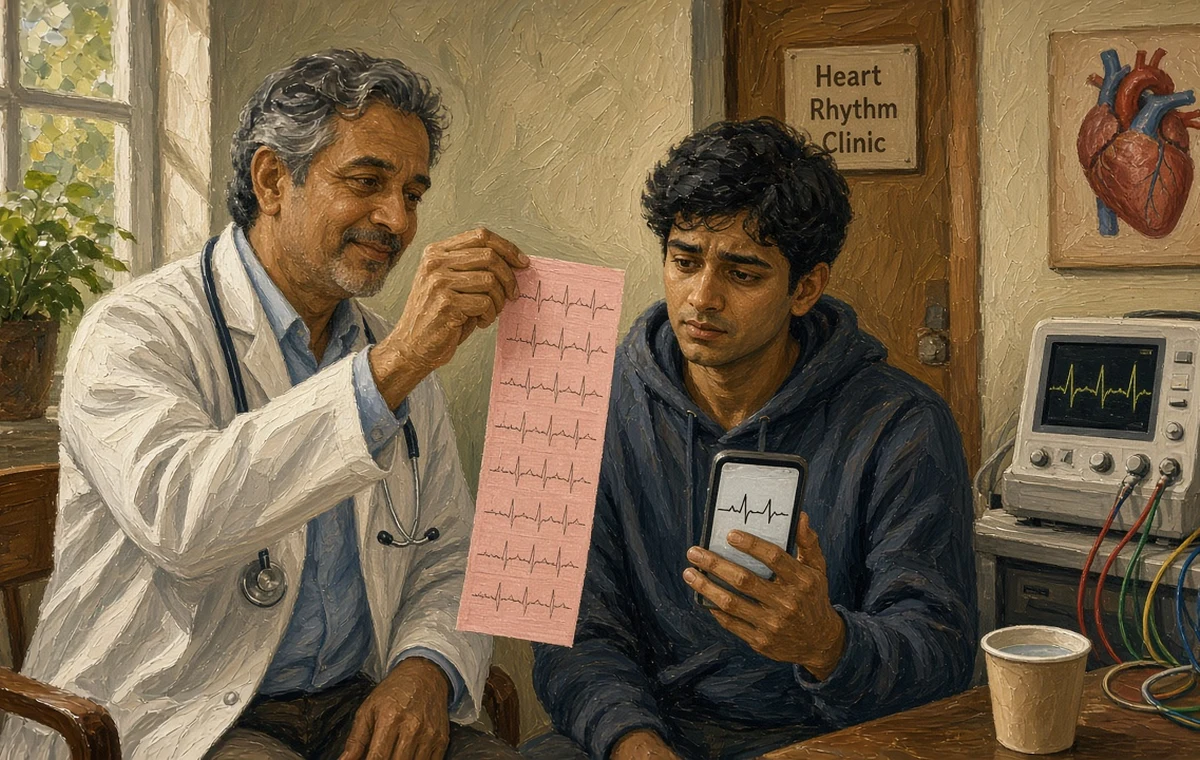
The watch has one clear advantage: it is there when symptoms happen. Palpitations that come and go often vanish by the time you reach the clinic, and a wrist recording can capture the moment. In practice the two tests complement rather than replace each other.
How are fall detection and emergency calls used?
- A hard impact followed by stillness can trigger an on-screen alert
- If you do not respond, some watches call emergency services or a saved contact automatically
- Alerts can fire if your heart rate stays unusually high or low
- Location sharing lets family check where you are
These features can support older people who live alone and people with long-term conditions. They also make mistakes. Vigorous exercise can trigger false alarms, while a slow slide to the floor may not be detected. A device works best alongside regular check-in calls or visits, not instead of them.

When recommending a device to an older person, plan charging and wearing time together. If the watch is on the charger at the moment someone falls, it cannot help, so a simple routine such as charging during breakfast and putting it back on straight after can make the difference.
Family members should also agree who receives alerts and what each person will do, because an alarm that nobody answers gives a false sense of safety.
What issues belong in a digital health assignment?
The first issue is accuracy and overdiagnosis. A healthy person who receives an alert may become anxious and seek repeated tests, which costs time and money and can lead to unnecessary treatment.
The second is privacy. Heart rate, rhythm and location are sensitive data. In the US, information held by a consumer app is often not covered by HIPAA unless it is shared with a healthcare provider or health plan, so users should read the app's privacy settings. In the UK, health data counts as special category data under the UK GDPR and needs stronger protection.
The third is equity. If the benefits go mainly to people who can afford a device and are comfortable with technology, health gaps may widen rather than shrink. A strong conclusion would argue that any rollout should come with education and support for older, poorer or less digitally confident groups.
| Part | Key question |
|---|---|
| Principle | What does the watch actually measure? |
| Accuracy | How often are alerts right or wrong? |
| Limits | What can a single lead not show? |
| Use | Who benefits, for example older people living alone? |
| Issues | Overdiagnosis, privacy and equity |
Reference: Perez, M. V., Mahaffey, K. W., Hedlin, H., et al. (2019). Large-scale assessment of a smartwatch to identify atrial fibrillation. The New England Journal of Medicine, 381(20), 1909 to 1917.
You got an atrial fibrillation alert. What should you do next?
Atrial fibrillation matters mainly because of stroke. When the upper chambers quiver instead of contracting properly, blood can pool and form clots that travel to the brain.
Also on CampusDown Repair Up: My Apple Watch Sits on the Charger and Does Absolutely Nothing.
People with atrial fibrillation are commonly described as having about five times the stroke risk of people without it, and many have no symptoms at all. That is why a watch that can spot silent episodes has drawn so much attention. The wiki entry on stroke covers warning signs such as face drooping, arm weakness and speech problems.
After an alert, the first step is to stay calm and arrange an appointment. Save the ECG trace to show your doctor. In the US you might see your primary care provider or a cardiologist. In the UK, your GP can arrange a 12-lead ECG and, if needed, an ambulatory monitor that records for 24 hours or longer. If you have chest pain, severe breathlessness, dizziness, fainting or sudden weakness on one side, call 911 or 999 immediately.
If atrial fibrillation is confirmed, the doctor will assess stroke risk to decide whether you need an anticoagulant. A common tool is the CHA2DS2-VASc score, which adds points for heart failure, high blood pressure, age, diabetes, previous stroke, vascular disease and sex. Higher scores mean anticoagulation usually brings more benefit. Explaining to patients that the watch is the start of a pathway, not the end of it, is an important nursing task.
- Save the alert and the ECG recording
- Book a review with a doctor soon
- Go to emergency care at once for chest pain, fainting or one-sided weakness
- Do not ignore symptoms just because there was no alert
- Work on blood pressure, alcohol, weight and sleep
The fourth point deserves emphasis. A watch only checks at certain moments, so it will miss some arrhythmias. Frequent palpitations or dizziness need assessment even if the watch stays quiet.
Lifestyle matters too. High blood pressure, heavy drinking, obesity, sleep apnoea and inactivity are all linked with atrial fibrillation. Cutting back on alcohol, losing weight and controlling blood pressure have been shown in studies to reduce episodes and symptoms. Regular moderate exercise such as brisk walking helps, and loud snoring is worth mentioning to a doctor because sleep apnoea can be tested for.
| Step | What happens | Key point |
|---|---|---|
| Alert | Irregular rhythm detected | Save the record, check for emergency symptoms |
| Clinic visit | 12-lead ECG, ambulatory monitoring | Confirm or exclude atrial fibrillation |
| Risk assessment | Stroke risk score | Decide whether an anticoagulant is needed |
| Treatment and self-care | Medicines, procedures, lifestyle changes | Blood pressure, alcohol, weight and sleep |
A smartwatch ECG is a useful tool for finding silent atrial fibrillation, but its value is realised only when the alert leads to an accurate diagnosis, a risk assessment and better daily habits. Read the buzz on your wrist as a signal to see a clinician, and it becomes genuinely useful.
FAQ
I got an alert but feel fine. What should I do?
It is not usually an emergency, but save the ECG recording and book a doctor's appointment soon.
Can a smartwatch detect a heart attack?
No. A single lead cannot rule out a heart attack, so call 911 or 999 for chest pain whatever the watch shows.
My watch shows a high heart rate all the time. Is that a problem?
Check for causes such as exercise, caffeine or fever. If it stays high at rest, see a doctor.
Does no alert mean I do not have atrial fibrillation?
No. The watch checks only at certain times and can miss episodes, so get symptoms checked anyway.
Who can see my heart data?
It depends on the app and its settings. Consumer apps are often outside HIPAA in the US, so review privacy options before sharing.